If you have been looking for web design services in The Gambia, the options are thin. International agencies charge well beyond what most local businesses can justify, and freelancers vary enormously in availability and in what happens once the work is handed over.
Sublex Digital sits between the two. We are based in The Gambia, we work to a written scope, and we stay involved after launch.
This post sets out exactly what we do, what it costs to start, who it suits, and who it does not.
On this page
Why the build is only the first part
Getting a website built is one thing. Keeping it online, fast, correct on a phone, and working after the developer has gone is another.
Plenty of businesses here have watched the second part fail. A site is built, looks well at launch, and then slowly comes apart. Links break. Updates are skipped. Content describes services that ended a year ago. The credibility the site was meant to build quietly drains away instead.
As more Gambians search before deciding where to spend, a trend documented in The Gambia’s Digital Economy Master Plan, a site that actually works stops being optional.
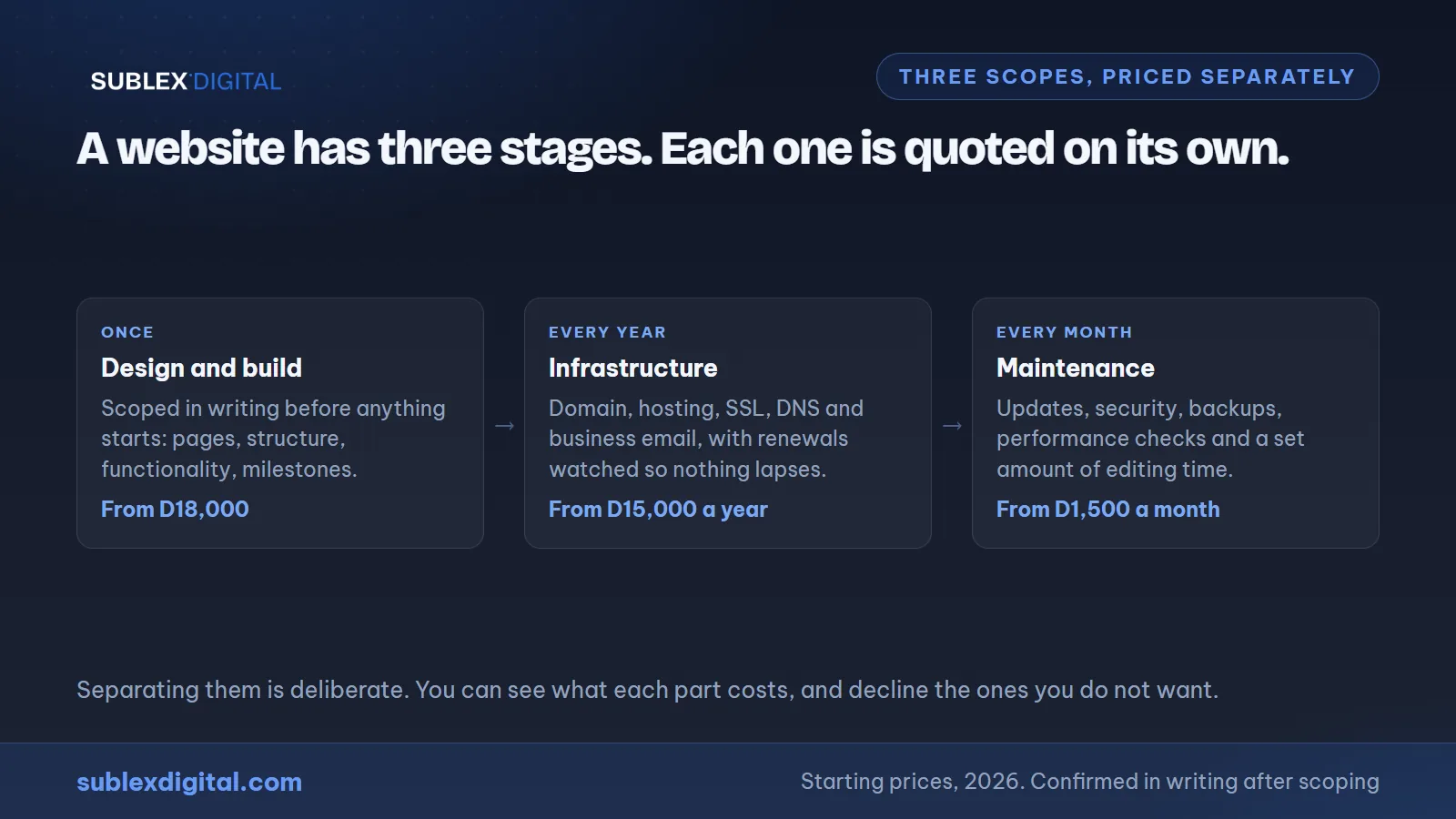
So the work is structured across the whole life of a site: design and build, infrastructure, and maintenance. Each is a separate defined scope, so you know what you are buying and what remains yours.
If you want the broader argument first, seven proven reasons every business in The Gambia needs a website and five costly mistakes with your online presence both go deeper.
Websites we design and build
Every project is scoped before any work starts: the number of pages, the content structure, the functionality, and the delivery milestones. Nothing begins without an agreed scope and terms in writing.
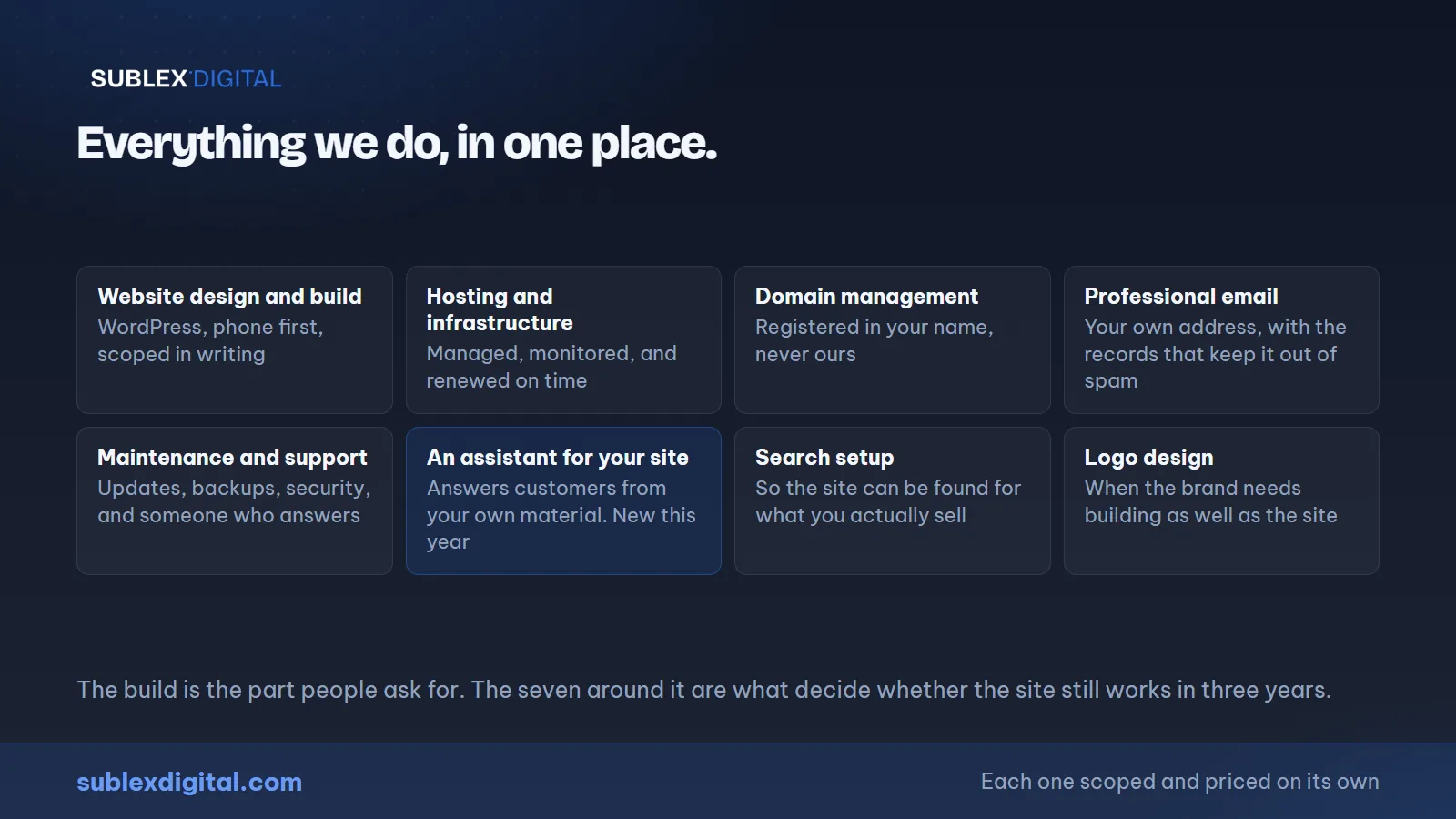
Sites are built on WordPress with a clean, light setup that favours speed and reliability over complexity, and they are designed for a phone first, because that is where nearly all of your visitors are.
Core business websites
For SMEs, clinics, law firms, hospitality businesses and service providers. Clear structure, a strong first screen, and contact and enquiry systems that actually reach you.
Institutional and school websites
Schools, training institutes and NGOs have different needs: programmes, news, staff pages, formal policy pages. We have delivered these and build them to the same standard as commercial work.
Online shops
WooCommerce stores with proper product pages, a cart and a checkout. These are scoped carefully, because a shop carries more complexity than a brochure site and needs specific ongoing maintenance to stay secure.
What it costs to start
Every project is different, which is the reason most agencies here publish no prices at all. It is a fair reason and it is still true. But asking somebody to book a call before they can find out whether a project is even within range of their budget wastes an afternoon that did not need to be spent.
So the starting prices are published. How much a website costs in The Gambia sets out all five packages with their starting figures, the yearly running costs, and what is included as standard. A five page site starts at D18,000 in
- Hosting, the domain and business email together start at D15,000 a year.
The final figure still depends on the scope, and it is confirmed in writing within 24 business hours of the consultation. What has changed is that you can find out roughly where you stand before speaking to anybody.
Domain, hosting and professional email
A website is only as reliable as what sits behind it. We handle domain registration, hosting, SSL and DNS, so none of it lands on somebody who did not sign up to administer a server.
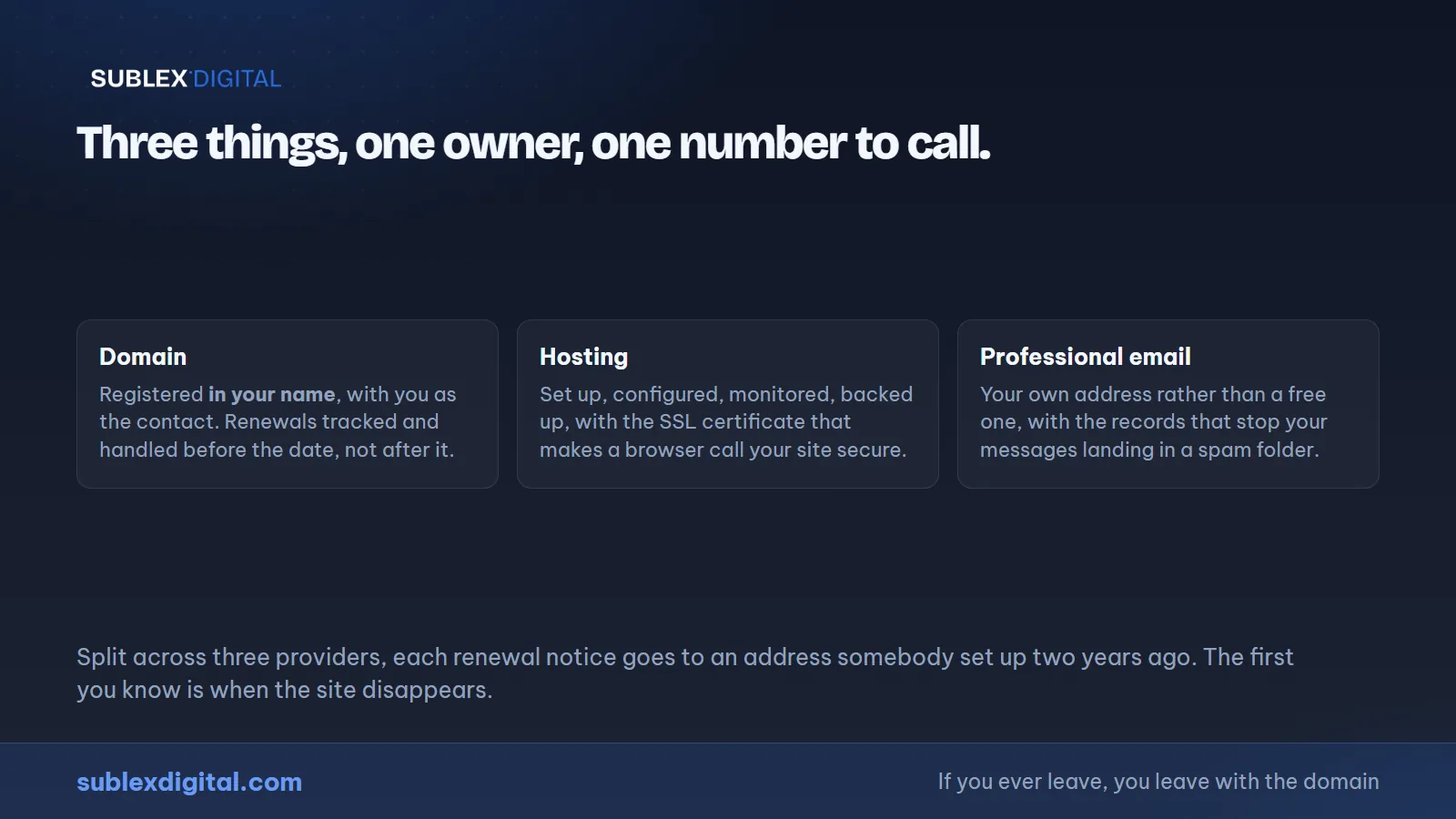
Professional email is part of the same setup, so you have info@yourbusiness.gm rather than a free address, which makes a real difference to how a business is read by customers and partners.
Renewal oversight is built in. Domains and hosting are tracked and renewed before they lapse, which prevents the specific and surprisingly common failure where a site disappears because a reminder went to an address nobody reads any more.
The domain is registered in your name. If you ever leave, you leave with it.
Maintenance after launch
Launching is not the end of the work. WordPress needs regular updates to its core, themes and plugins, and without them security holes accumulate until something breaks or is broken into.
Maintenance plans cover updates, security scans, backups, performance checks and a defined amount of editing time each month, tiered by how much support an organisation actually needs. They start at D1,500 a month.
Maintenance is deliberately separate from the build. That way the scope of ongoing support is agreed on its own terms and nobody pays for a level of service they do not need.
An assistant that answers your customers
A working website generates enquiries, and somebody has to answer them. In practice that is usually the owner, on WhatsApp, at half past nine at night, answering the same handful of questions for the fourth time that week. Where are you. Do you deliver to Brikama. How much is the small one.
Sublex Chat is our own product, built for exactly that. It sits on the website and answers from what your business has given it, which means it will not invent a price or an opening time, and when it does not know something it says so and takes the customer’s number so you can follow up.
It can be set up alongside a new build or added to a site you already have, and it is managed as part of the same relationship as everything else here.
What actually happens, and when
The other thing missing from most quotes here is a timeline anybody can hold you to. This is ours for a five page site.
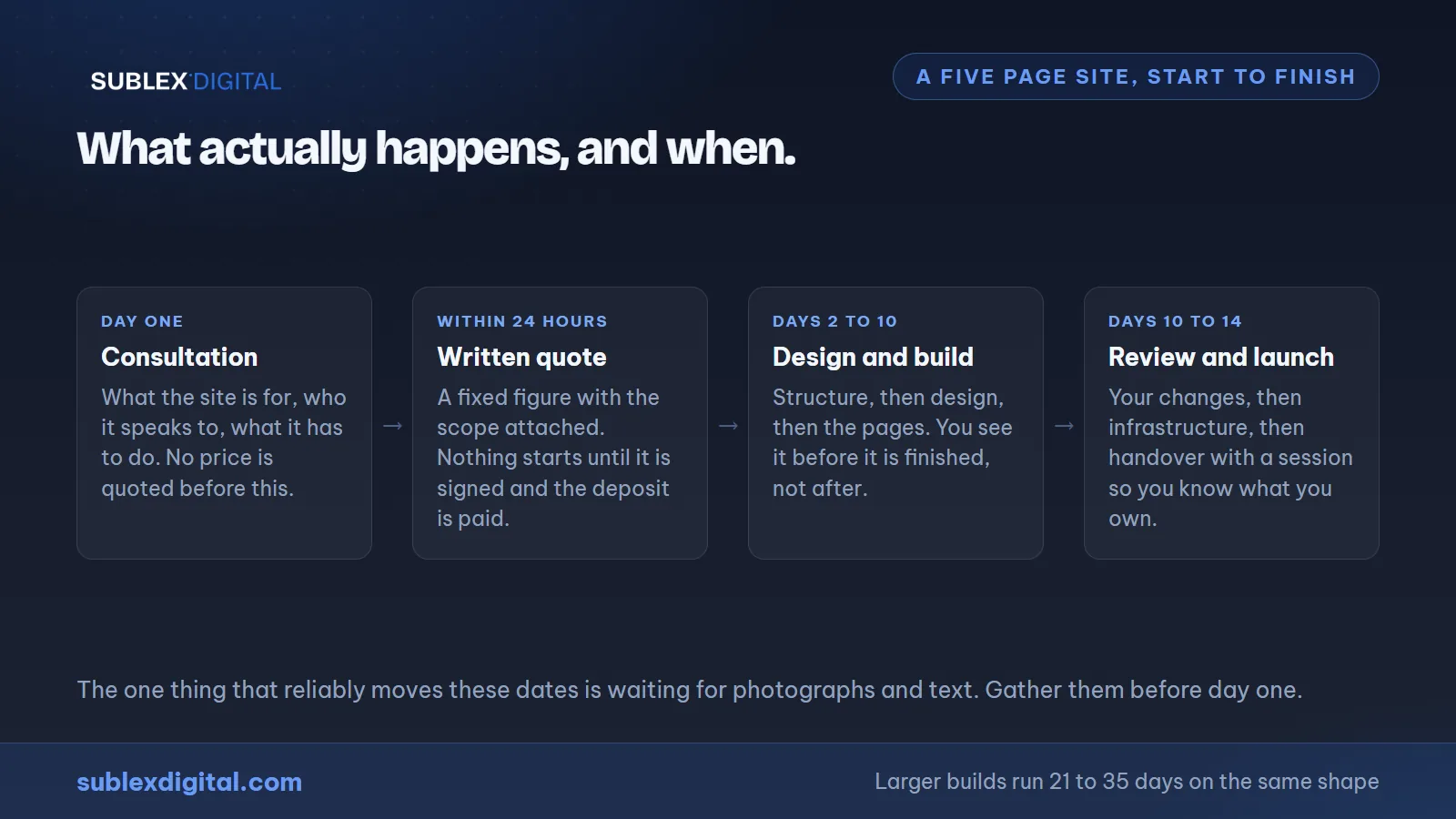
Day one is the consultation. What the site is for, who it speaks to, what it has to do, and what you already have. No price is quoted before this conversation, because a price quoted before it would be a guess.
Within 24 business hours, a written quote. A fixed figure with the scope attached, saying what is included and what is not. Nothing starts until it is signed and the deposit is paid, which protects you as much as us.
Days two to ten, design and build. Structure first, then design, then the pages themselves. You see it while it is being built rather than at the end, because a change on day four costs nothing and the same change on day twelve costs a rebuild.
Days ten to fourteen, review and launch. Your changes, then the infrastructure, then handover with a session so you know what you own and how to use it.
A ten page business site runs 14 to 21 days on the same shape, and an institutional or e-commerce build 21 to 35.
The one thing that reliably moves these dates is content. Waiting for photographs and text is the cause of nearly every delayed project, ours included. Gathering what you already have before day one will shorten the work and sharpen the quote.
What the project needs from you
A defined scope cuts both ways. Here is the part that is yours, said plainly, because a project stalling for six weeks usually stalls on one of these.
The words. Not polished copy, just a straight description of what you do, for whom, and what makes somebody choose you. We can write from that. We cannot write from nothing.
The photographs. Of the real place, the real work and the real people. Stock photographs of an office in another country are recognised instantly and they undo the credibility the site is meant to build.
One person who decides. Not a committee assembled at the review stage. Feedback from four people who disagree with each other costs more days than any technical problem.
Answers within a few days. The build pauses when a question goes unanswered, and a project paused long enough has to be picked up again from cold, which helps nobody.
None of that is difficult. It just needs somebody to have decided it is worth half a day, and the projects that go quickly are the ones where somebody did.
Who we work with, and who we do not
The focus is businesses and institutions in The Gambia. Recent work gives the range.
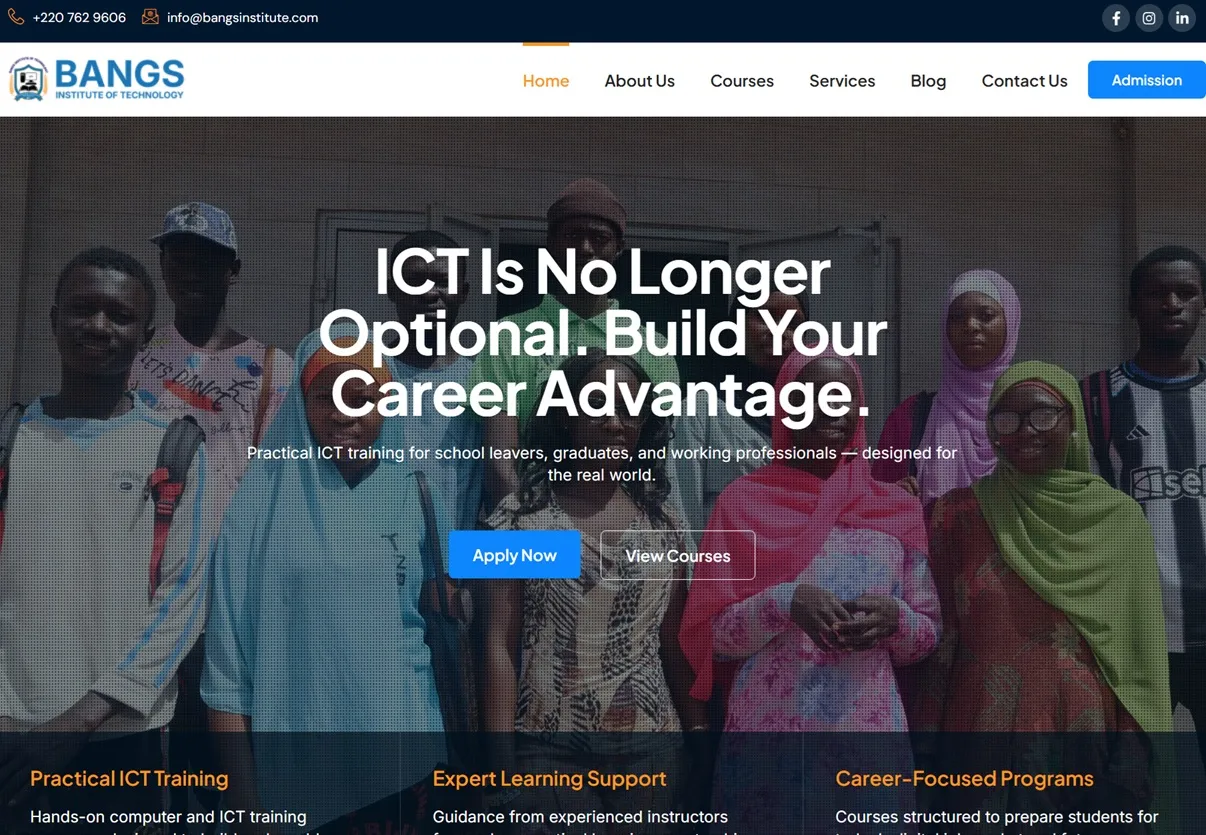
Bangs Institute of Technology, a private training institute. Institutional sites have a particular problem: a prospective student, a parent paying the fees and a partner organisation all arrive wanting different things from the same handful of pages. The structure had to serve all three without becoming a maze.
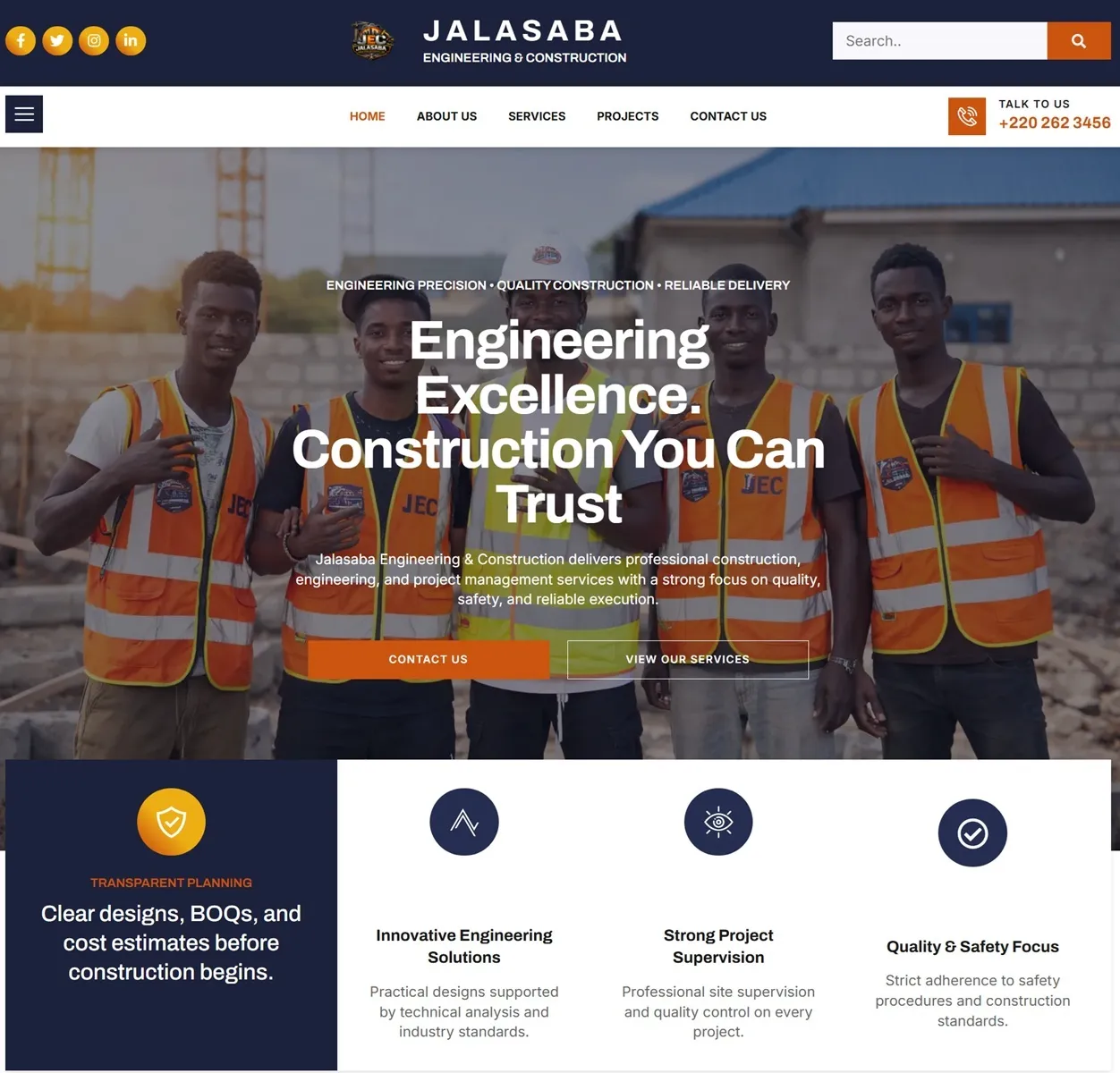
Jalasaba Engineering and Construction, a construction and engineering firm. Here the work is the argument. Somebody deciding whether to award a contract wants to see finished projects and judge the standard, so the site is built around showing the work rather than describing it.
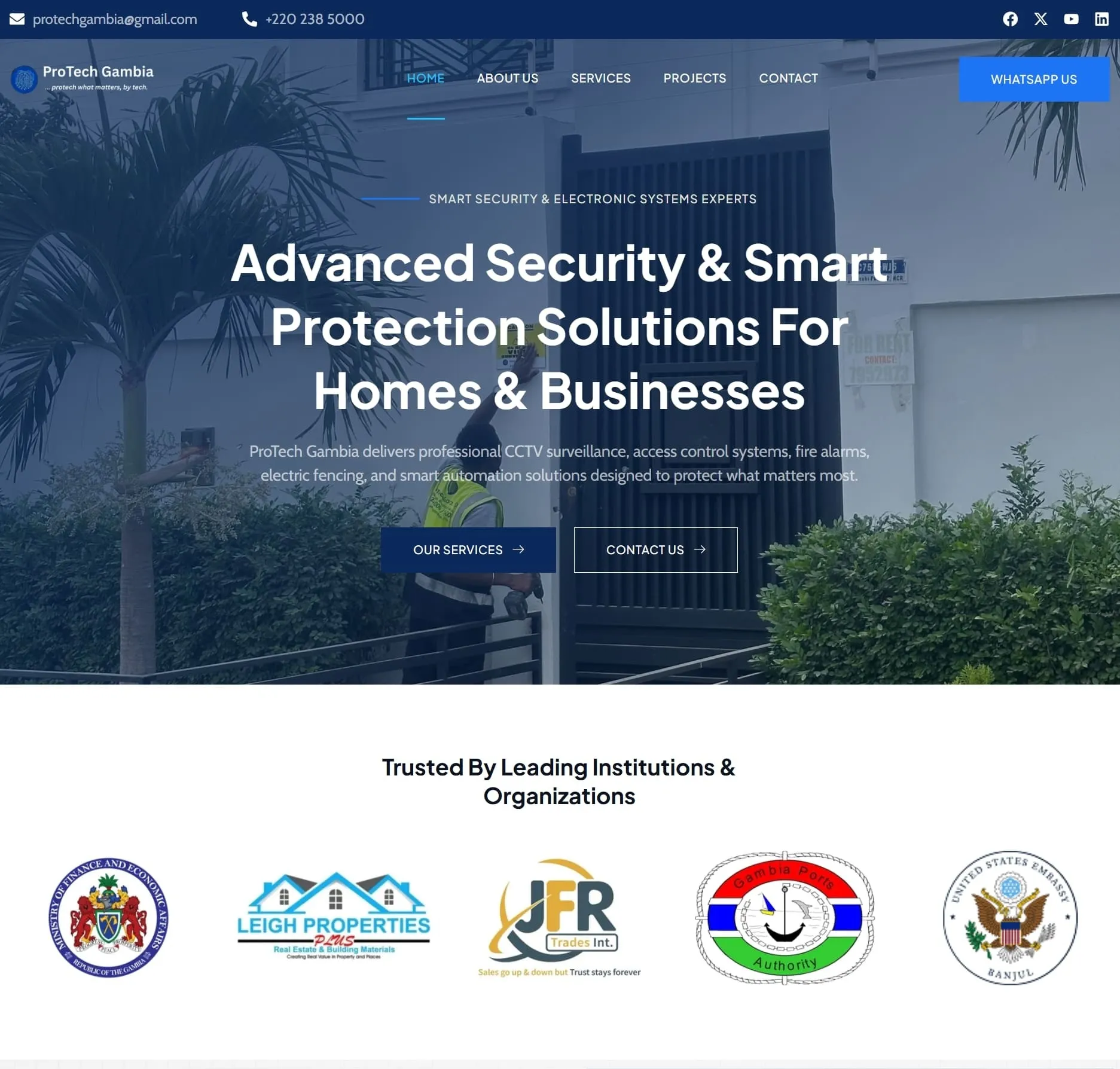
ProTech Gambia, a technology equipment supplier. Site, domain and professional email delivered together and handed over with an active infrastructure plan, which is the arrangement we recommend because it leaves one place to call rather than three.
EasyTechDigest, a technology news platform. A publishing site has different demands from a company site: articles go up often, so the person adding them cannot need a developer, and the reading experience matters more than anything decorative.
The work is on the portfolio page, and the about page covers the background.
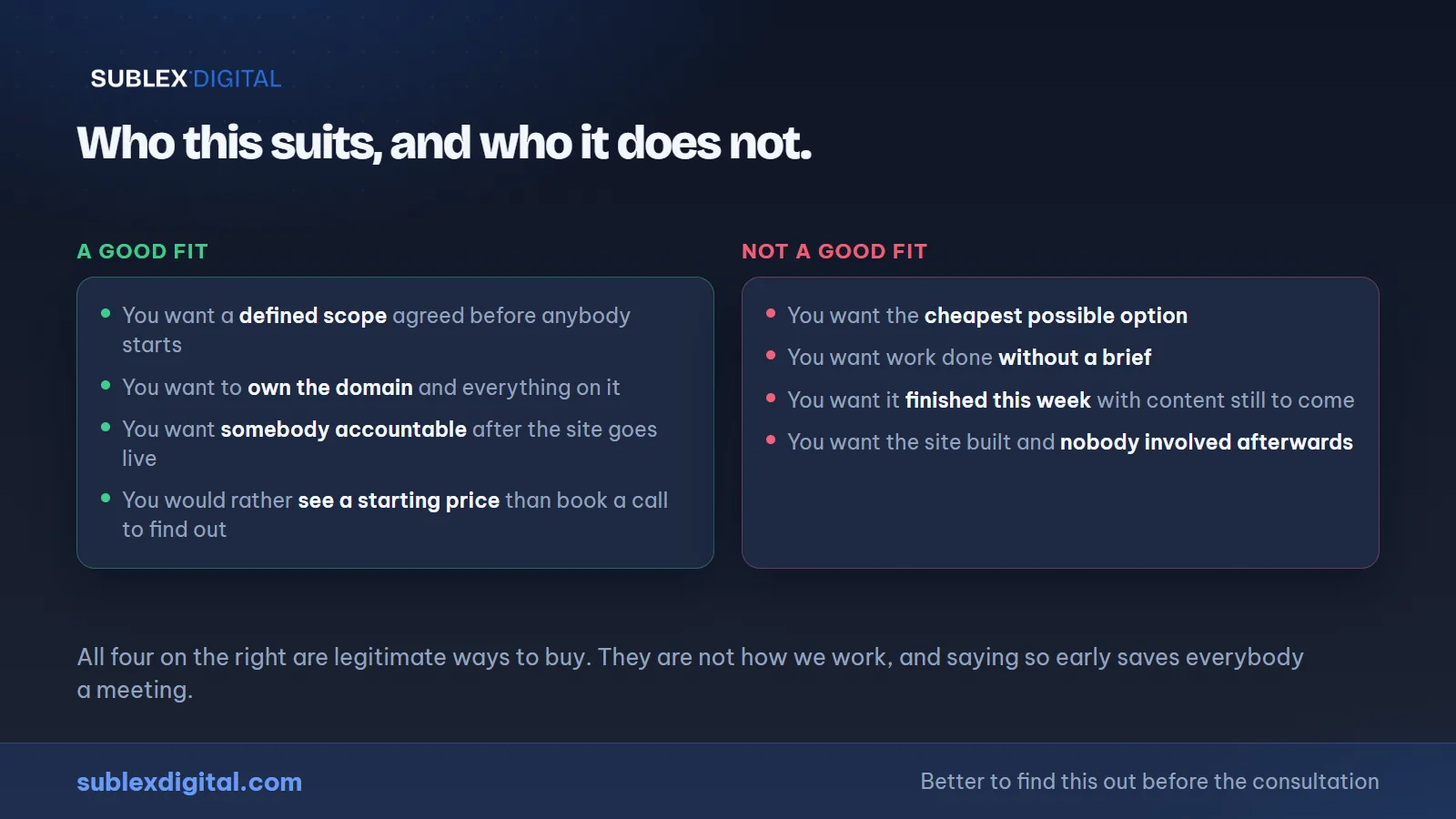
We are a good fit for organisations that want a defined scope, clear communication, and somebody accountable after the site goes live.
We are not a good fit for anyone who wants the cheapest possible option, or who wants work done without a brief. Both of those are legitimate ways to buy. They are not how we work, and saying so early saves everybody a meeting.
How a project runs
Half of the fee is paid before work begins and half before the site goes live. Rush delivery under five working days carries a surcharge, because it means other work moves. Twelve months of hosting or maintenance paid upfront takes 10% off.
Those terms are the same for everybody and they are on the quote, not buried somewhere.
You can book a consultation directly, or browse the full list of services first. There is no obligation to proceed.
Frequently asked questions about web design services in The Gambia
How much do web design services in The Gambia cost?
At Sublex Digital a five page site starts at D18,000 in 2026, a ten page business site at D28,000, and an institutional or e-commerce build higher. Hosting, domain and email together start at D15,000 a year, and maintenance at D1,500 a month. The final figure depends on the scope and is confirmed in writing within 24 business hours.
What is included in a website project?
A mobile first design, a WordPress CMS you can use, on-page SEO setup, Google Analytics, SSL, a contact form, and post-launch support. The domain is registered in your name. What is not included is the yearly running cost, which is quoted separately so you can see both halves.
Do you work with businesses outside The Gambia?
Yes. International and diaspora clients are quoted in US dollars on the same packages, starting at $600, with the same inclusions.
How long does a project take?
A five page site is 7 to 14 days once the content is ready, a ten page site 14 to 21, and an institutional or e-commerce build 21 to 35. The usual cause of delay is waiting for photographs and text.
Can you take over a website somebody else built?
Yes, provided you can prove you own the domain. A migration moves the files, the database and the DNS, and it is a fixed one-off fee rather than a rebuild. There is a support period afterwards, because the problems that follow a migration appear in the first fortnight rather than on the day.
Do I have to take a maintenance plan?
No. It is a separate decision from the build and it is priced separately for that reason. What we will not do is imply that a site left unmaintained for two years will be fine, because it will not.
What is Sublex Chat?
Our own assistant product. It goes on a website and answers customer questions from the material the business gives it, so it does not invent prices or opening times, and it takes a phone number when it cannot answer. It can be added to an existing site.
Do you build sites for businesses outside Banjul and Kanifing?
Yes. The work happens over calls, messages and email, and a site for a business in Basse is built the same way as one for a business in Serrekunda. Where an in-person meeting genuinely helps we arrange one, but no project depends on you being nearby.
What if I already have a designer and just need hosting?
Infrastructure is available to clients whose sites we build or actively manage, so on its own the answer is usually no. That is not an upsell. Managing hosting for a site somebody else maintains means being accountable for something we cannot control, and when it breaks nobody can say whose problem it is.
What if I only need one page?
That is a reasonable place to start, and a single well-built page that loads fast, says what you do and makes contact easy will do more than a large site that never gets finished. Say so at the consultation and it will be scoped that way.
Can I add pages later?
Yes, and most clients do. Pages added after the original scope are priced per page rather than as a new project, and because the design and structure already exist a new page is usually a short job. What costs more is deciding halfway through the original build that the site needs twice as many pages, which is why the scope is agreed in writing first.
Who writes the content?
You provide the raw material and we structure it. If what you have is a few paragraphs and a list of services, that is enough to work from. Full copywriting is a separate service for clients who would rather hand the whole thing over, and it is quoted on its own.