More Gambian businesses are asking the same question: how do you actually sell online in The Gambia? Not in theory, but practically. What does it take to set up a working online store, get orders through a website, and collect payment when Stripe and PayPal are not available to most Gambian sellers? This guide answers that question step by step. It covers where to sell, how orders work in the Gambian context, what payment options your customers will actually use, and how to build the trust that turns website visitors into paying customers.
In this post
The Reality of Selling Online in The Gambia Right Now
The Gambia’s e-commerce market is at an early but real stage of development. According to DataReportal’s Digital 2025 report, there are 1.28 million internet users in the country, with mobile connections at 113% of the total population. The vast majority of people browsing your products are on a smartphone. Social media is where most Gambian businesses currently promote their products and services, predominantly through Facebook, Instagram, and WhatsApp.
What the market does not yet have at scale is seamless online payment. Stripe, PayPal, and similar international payment gateways are unavailable or effectively inaccessible to most Gambian merchants. This is not a barrier to selling online. It simply means the model works differently here, and understanding that model is the key to making it work for your business.
The businesses that are successfully selling online in The Gambia today are doing it by combining a proper online presence with a practical offline payment and delivery arrangement. That combination is what this guide covers.
Step 1: Know What You Are Selling and Who You Are Selling To
Before you set up any platform or website, spend time on two questions. First, what exactly are you selling? This means having a clear product or service list with descriptions, photos, and prices. Second, who is your customer? Are they in Banjul or Serrekunda, or are they Gambian diaspora in Europe and America ordering for family back home? The answer shapes everything from the platform you choose to the payment methods you offer to the way you write your product descriptions.
Businesses that skip this step end up with a website or social media presence that is technically live but vague. Customers arrive and cannot quickly understand what is on offer, who it is for, or how to order. That ambiguity kills sales before they start.
Take time to list every product or service you plan to sell online, write a clear one-paragraph description of each, set your prices, and describe who benefits from each one. That material becomes the foundation of everything else.
Step 2: Choose Where to Sell Online in The Gambia
Start with Social: Facebook, Instagram, and WhatsApp
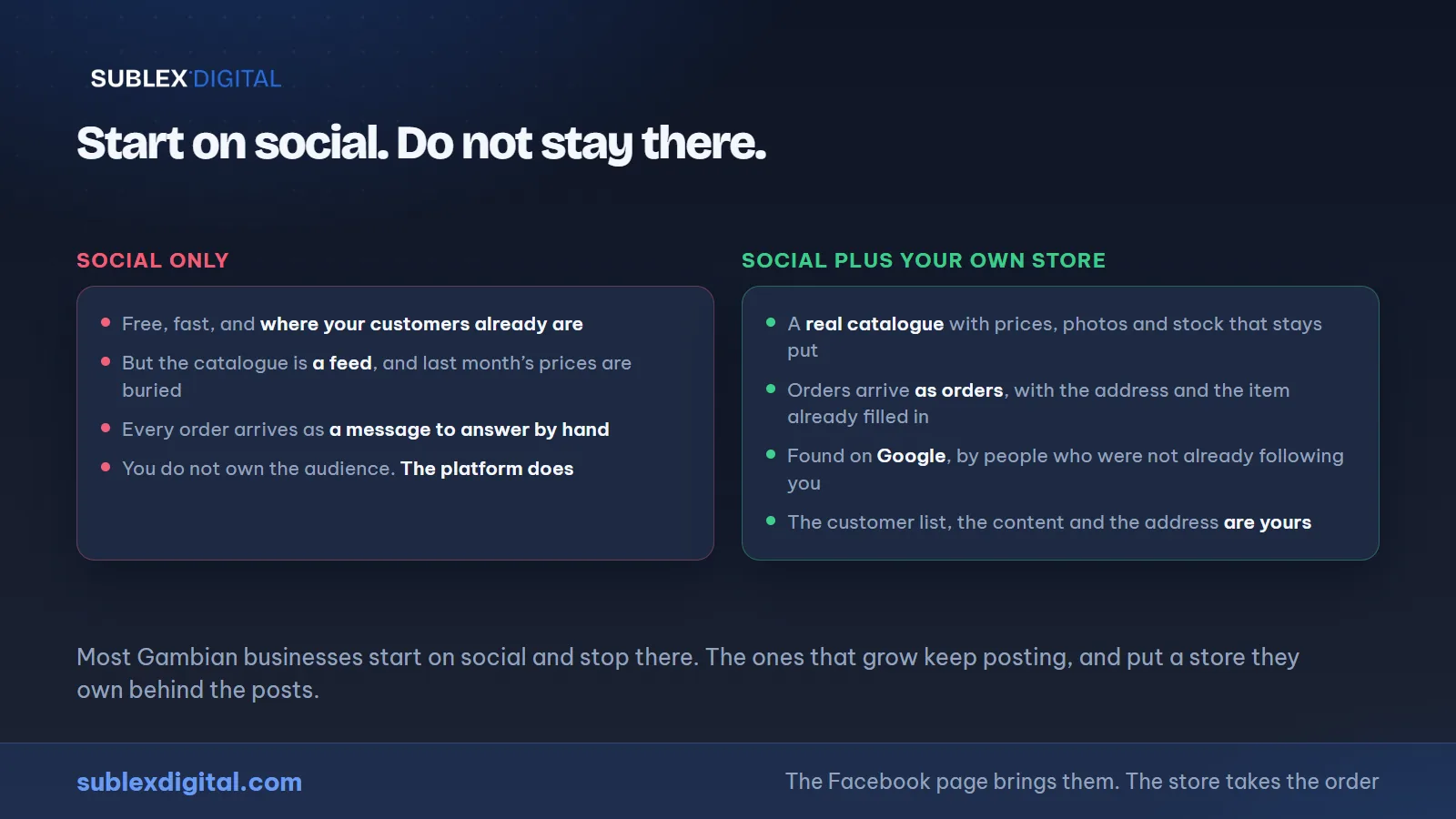
For most Gambian businesses, social media is the right starting point. Facebook is still the dominant platform in The Gambia, with the highest reach and the most established business pages. Instagram works well for visual products like food, fashion, crafts, and beauty items. WhatsApp Business is where most order conversations happen.
Setting up a Facebook Business Page and a WhatsApp Business account is free and can be done within a day. These give your business a public presence where customers can discover your products, see photos, read descriptions, and message you directly. Many Gambian businesses sell entirely through this combination and do well with it.
The limitation is the one raised in every previous post in this series: you do not own these platforms. Algorithm changes can cut your reach. Your account can be restricted. And social media alone does not give you the structured product catalogue, order system, and customer management that a website provides.
Build Your Own Online Store
A website with an integrated online shop gives you a platform you own and control. For most Gambian businesses, this means a WordPress site with WooCommerce, the world’s most widely used e-commerce plugin. WooCommerce allows you to list products with photos, descriptions, and prices, and gives customers a proper checkout experience with an order form they complete on the website.
Critically, WooCommerce has a built-in “Cash on Delivery” payment option that is specifically designed for exactly the model used in The Gambia: customer places the order on the site, and payment is collected separately when the goods are delivered or picked up. No online payment gateway is required. The order is captured on the website, you receive a notification, and you contact the customer to arrange delivery and payment. This is not a workaround. It is a fully supported, professionally used e-commerce model that works well in markets where card payment infrastructure is limited.
Read more about what a well-structured website looks like in the post 7 Proven Reasons Every Business in The Gambia Needs a Website, or review the web design services Sublex Digital offers for online stores.
Step 3: Understand How the Order Flow Works in The Gambia
This is the section most guides skip, and it is the most important one to get right for anyone trying to sell online in The Gambia.
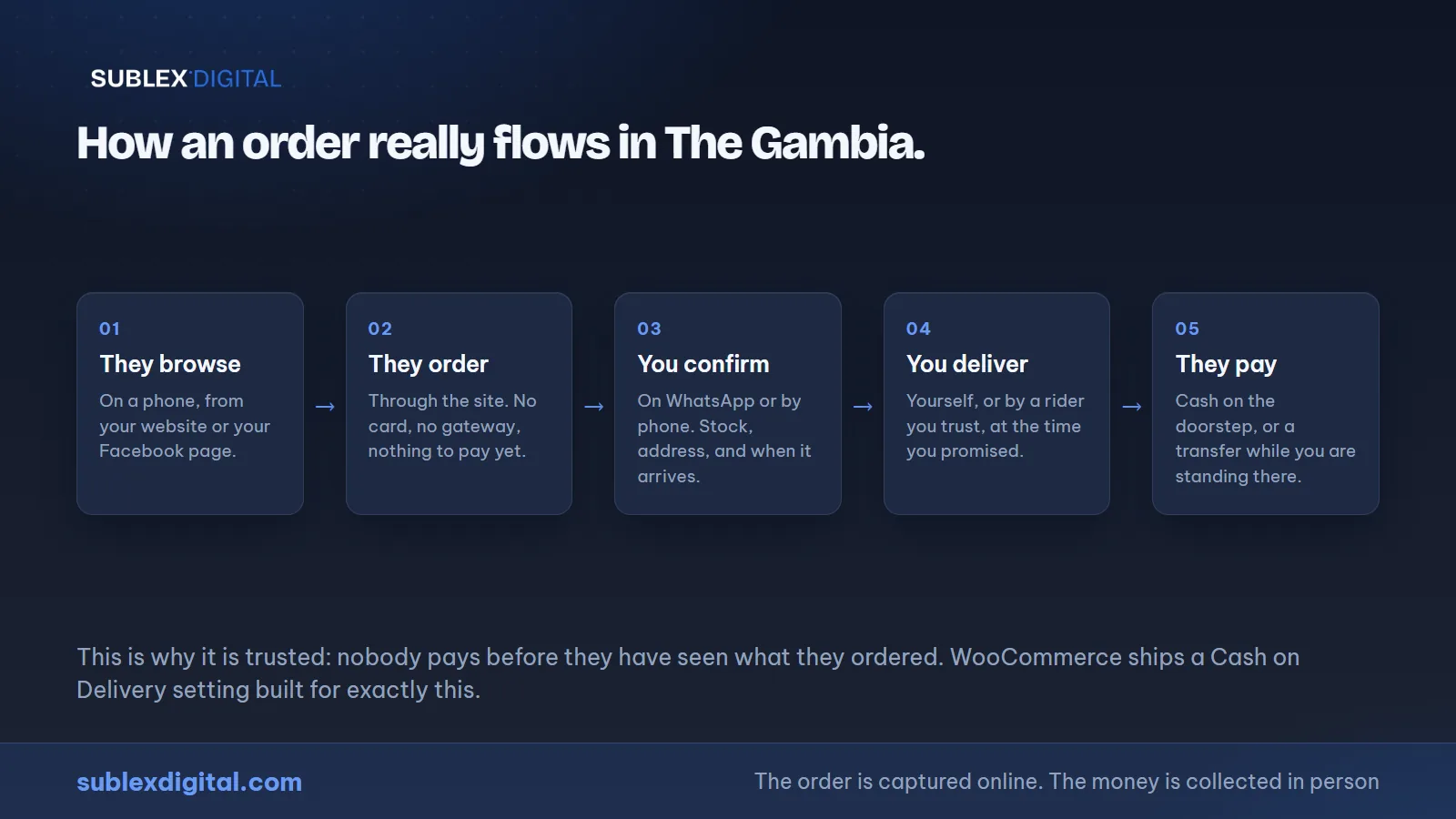
In most international e-commerce setups, the customer browses, adds to cart, checks out, pays online, and the seller ships. In The Gambia, the process is different. The customer browses the website, adds to cart, and completes the order form on the site. No payment is made at checkout. The order is submitted and the seller receives a notification.
The seller then contacts the customer, usually via WhatsApp or phone, to confirm the order, check the delivery address or pickup arrangement, confirm what payment method the customer will use, and agree on a time. Payment happens at the point of delivery or pickup, in cash, Wave, Afrimoney, QMoney, APS Wallet, or by bank transfer depending on what works for both parties.
This model works. It is trusted by Gambian customers because they do not have to pay before seeing the product. It is practical for sellers because it does not require any payment gateway integration. The key is setting it up cleanly so customers understand it at checkout, and so sellers handle the confirmation step quickly and professionally.
On the technical side, WooCommerce handles this with its Cash on Delivery setting. When enabled, customers select “Pay on Delivery” or “Pay on Collection” at checkout, submit their order, and receive an order confirmation email. The store owner receives the order in the WooCommerce dashboard and contacts the customer to arrange the rest. Many sellers also add a WhatsApp Business integration so order details are sent directly to their WhatsApp the moment an order is placed.
Step 4: Set Up Your Payment Options
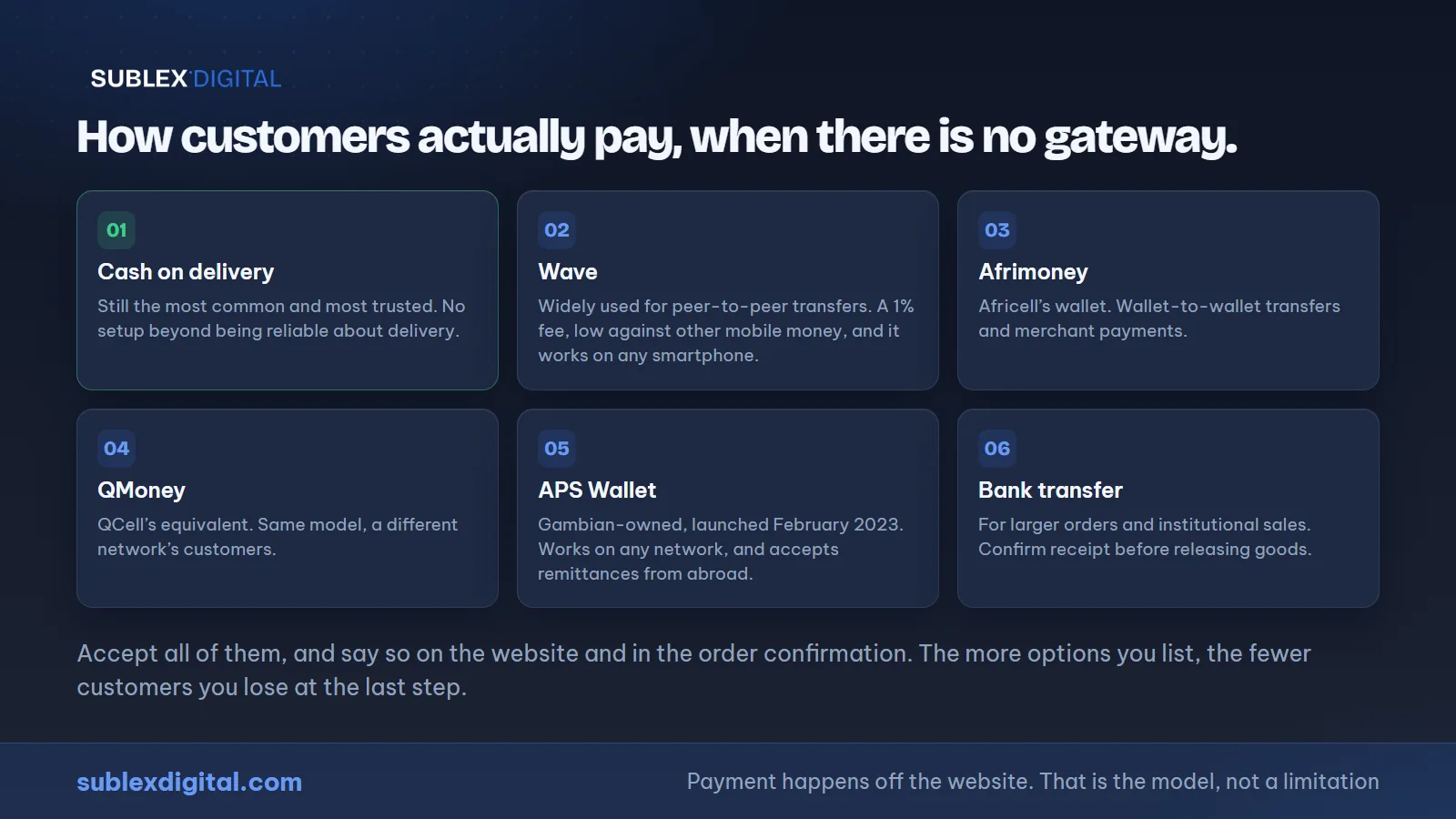
Since payment happens off the website, the options you accept depend on what your customers have access to and what is practical for you to collect. Here are the main options used by Gambian online sellers.
Cash at delivery or collection is still the most common and most trusted method. Many customers, particularly first-time buyers, prefer to pay cash when they can see and inspect what they ordered. It creates no friction and requires no setup on your part beyond being reliable about delivery.
Wave is widely used in The Gambia for peer-to-peer transfers. Customers who have Wave can send payment to your Wave number instantly. The 1% transfer fee is low compared to other mobile money services, and the app works on any smartphone. Wave is confirmed operational in The Gambia and has a dedicated customer support line at 1222.
Afrimoney, operated by Africell, and QMoney, operated by QCell, are the telecom-backed mobile money options. Both allow wallet-to-wallet transfers and merchant payments. Customers using these services can send payment when collecting or having an item delivered, or ahead of time if they trust the seller.
APS Wallet is a Gambian-owned digital wallet launched in February 2023. It works with any Gambian mobile number and network, allows local money transfers, bill payments, and mobile credit top-ups, and is accessible through a dedicated app. For diaspora customers, the APS platform also allows international remittances directly into Gambian wallets, which makes it particularly useful for sellers targeting overseas buyers.
Bank transfer is used less frequently for smaller purchases but is appropriate for larger orders, institutional sales, or customers who prefer it. It requires sharing your bank account details and confirming receipt before releasing goods.
The practical recommendation is to accept all of the above. State clearly on your website and in your order confirmation message which payment methods you accept. The more options you offer, the fewer customers you lose at the payment stage.
Step 5: Handle Delivery and Build Customer Trust
Delivery is where most Gambian online selling attempts fall apart. Either there is no clear system, the seller is unreliable, or the customer is not home when delivery is attempted and the order fails. Getting delivery right is as important as getting the website right.
For businesses in Greater Banjul, the most practical options are self-delivery for nearby orders, using a local courier or motorbike rider for same-day delivery, or offering a pickup point at your premises or a fixed location. Be specific on your website about where you deliver, how long it takes, and whether there is a delivery charge.
Trust is the other half of this equation. Customers who have never bought from your business before are taking a risk. They have seen a product online and are considering placing an order without paying first. What reduces that risk is evidence: product photos that clearly show what they are buying, accurate descriptions, a visible WhatsApp number or phone contact on your site, and, over time, positive reviews or testimonials from previous buyers.
The questions that arrive before an order are usually the same handful: do you deliver to Brikama, how much is delivery, is this still in stock, can I pay on the doorstep. They arrive in the evening, and an answer the next morning is often a sale that has already gone elsewhere. An assistant on the site can answer those from your own price list and delivery terms while you are asleep, and take the customer’s number when the question is one only you can answer.
Sublex Chat is ours, and it is built on the same principle as the rest of this guide: it answers from what you gave it and nothing else, so it cannot promise a delivery date or a price you never set.
The post 6 Critical Things to Check When Hiring a Website Design Company in The Gambia covers how a well-built website contributes to credibility in detail. The same principles apply to your product store. A clean, professional site with real product photos and clear contact details signals to customers that you are a legitimate business worth trusting.
Step 6: Promote Your Business to the Right Audience Online
Setting up your store is the foundation. Getting customers to it is the ongoing work. For most Gambian businesses, the most effective promotion channels are Facebook, Instagram, and WhatsApp, combined with word of mouth and, over time, Google Search.
Facebook posts with clear product photos and prices still reach a significant audience in The Gambia, particularly if you boost them to target people in specific areas or with specific interests. Instagram is better for visual products and reaches a younger audience. WhatsApp broadcasts to existing contacts are highly effective for repeat customers and promotions.
Google Search is the channel most Gambian businesses underuse. When someone in The Gambia searches for your type of product or service, a website with good content has a chance to appear. A social media page does not. Over time, consistent content on your website builds visibility in search results that social media cannot replicate.
If your current digital presence is costing you customers because you cannot be found online, the post 5 Real Reasons Your Online Presence in Gambia Is Costing You Customers covers why this matters specifically for Gambian businesses.
The Diaspora Opportunity Gambian Sellers Should Not Ignore
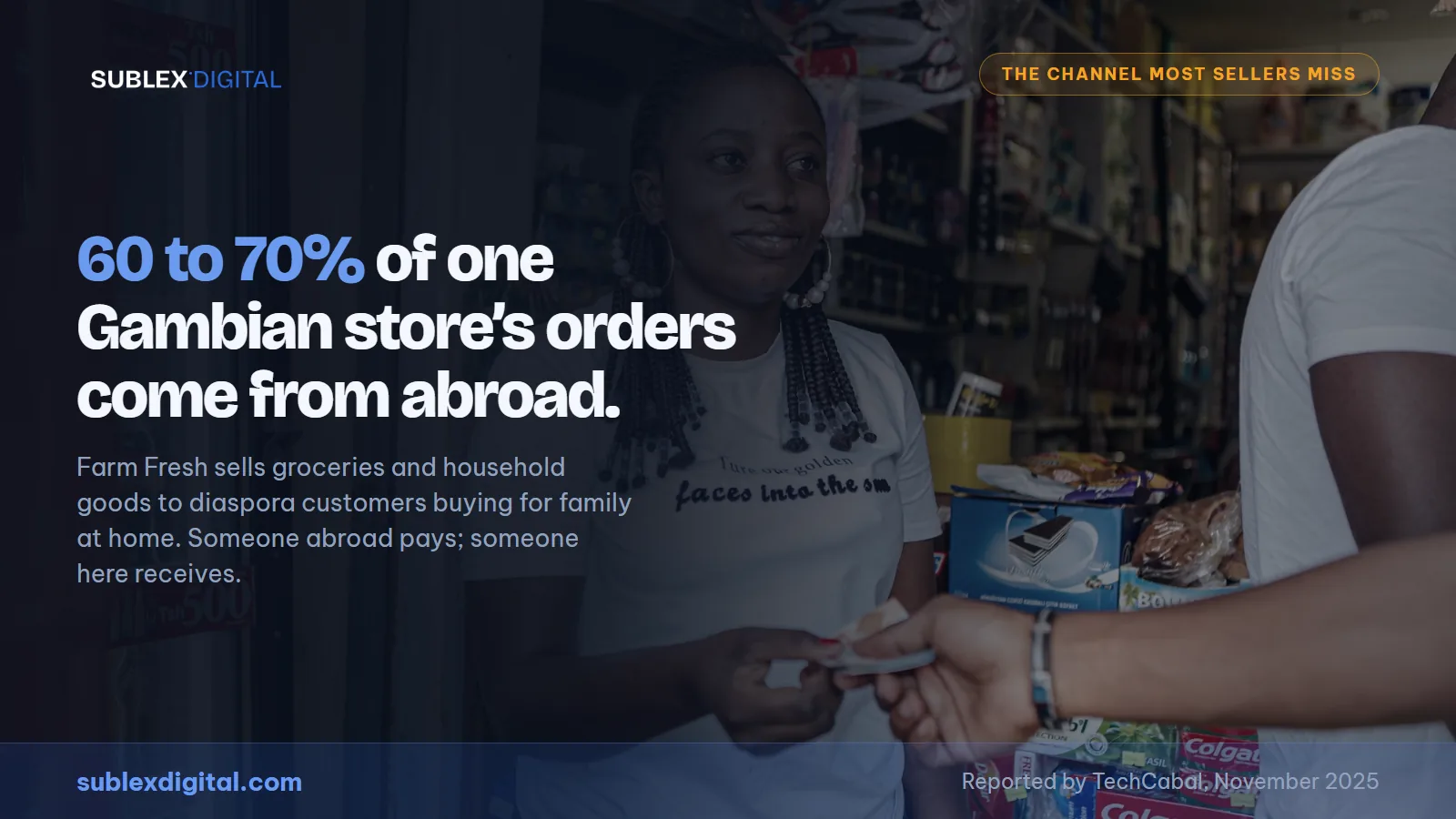
One of the most underused channels for Gambian businesses trying to sell online in The Gambia is the diaspora market. Formal remittance inflows to The Gambia reached US$872 million in 2025, equivalent to approximately 30% of national GDP. Gambians living in Europe and North America regularly send money to support family members at home, and many of them are looking for ways to send goods and services directly rather than just cash.
Farm Fresh, one of The Gambia’s most established e-commerce businesses, reports that 60 to 70% of its online orders come from the diaspora, with diaspora customers buying groceries, household supplies, and food items for family members in The Gambia. That model works for many types of businesses, not just food. Clothing, electronics, household goods, and services can all be ordered by diaspora customers and collected or delivered locally.
For sellers targeting this market, APS Wallet is particularly relevant because it accepts international remittances that can be used for local purchases. The key is making your website and product listings clear enough that someone browsing from the UK or the US can understand exactly what they are ordering and how their family member in The Gambia will receive it.
Common Mistakes When You Try to Sell Online in The Gambia
Posting products without prices. If customers have to message you to ask how much something costs, most of them will not bother. Put your prices on every product listing, on your website and on social media.
Using low-quality product photos. In an online store, the photo is all the customer has to judge the product by. Blurry, dark, or cluttered photos reduce trust immediately. Natural daylight, a plain background, and a steady phone camera are all you need.
Slow responses after an order is placed. When a customer submits an order on your website, they expect to hear from you within hours, not days. If you go quiet after they order, they will assume something is wrong and may not buy again.
No clear delivery information. Customers want to know how long delivery takes, what it costs, and how far you deliver. If this is not stated clearly, some customers will not order at all rather than ask.
Trying to solve the payment problem with complex tools before the basics are in place. The order-online, pay-on-delivery model works for selling online in The Gambia right now. Getting a clean website, a reliable WhatsApp confirmation process, and consistent delivery in place is more valuable than searching for a payment gateway that works in The Gambia. Build the foundation first.
Frequently Asked Questions About How to Sell Online in The Gambia
These are the questions we hear most often from business owners who want to sell online in The Gambia.
Do I need a website to sell online in The Gambia?
Not to get started. Many Gambian businesses sell effectively through Facebook pages and WhatsApp alone. But a website gives you a structured product catalogue, a proper order system, and a presence on Google that social media cannot provide. If you are serious about growing your online sales, a website is the right investment. A social media presence and a website work best together.
How do customers pay for online orders in The Gambia?
Most customers pay at the point of delivery or collection, not through the website. Common payment methods are cash, Wave, Afrimoney, QMoney, and APS Wallet. Some customers also pay by bank transfer. The website captures the order, and payment is arranged separately when you contact the customer to confirm delivery. This is how most Gambian online stores operate, and WooCommerce has a built-in option specifically for this model.
What if my customers prefer to pay cash?
Cash is still the most common payment method in The Gambia and is completely compatible with selling online. The customer places their order on your website, you contact them to confirm, and they pay in cash when they receive the item or collect it from you. This is a normal, widely used model and requires no special setup beyond a well-configured WooCommerce store with the Cash on Delivery option enabled.
How do I handle delivery for online orders in The Gambia?
The most practical options for businesses in Greater Banjul are self-delivery for nearby orders, using a local motorbike courier for same-day delivery, or offering a fixed pickup point. Be specific on your website about your delivery area, delivery time, and any delivery charge. Customers who know exactly what to expect are more likely to complete their order and more likely to come back.
Can I sell to Gambians living abroad?
Yes. The diaspora market is one of the most significant opportunities for Gambian online sellers. Gambians living in Europe and North America regularly purchase goods for family members in The Gambia. Farm Fresh, one of The Gambia’s established e-commerce businesses, generates 60 to 70% of its orders from diaspora customers. To serve this market, your website needs to be clear enough for someone browsing from overseas to understand what they are ordering and how their family in The Gambia will receive it. APS Wallet and bank transfer are the most practical payment options for international orders.
How much does it cost to set up an online shop in The Gambia?
The cost depends on the size of your product catalogue, the complexity of your website, and what infrastructure is needed. Sublex Digital scopes every project individually based on what the business actually needs. The post How Much Does a Website Cost in The Gambia? gives a clear breakdown of the factors that affect cost. The best starting point is a free consultation to discuss your specific requirements.
Ready to Start Selling Online?
Selling online in The Gambia does not require solving the payment gateway problem before you start. It requires a clear product offering, a well-built website that captures orders properly, a reliable WhatsApp confirmation process, and a delivery arrangement your customers can count on. That combination works in this market right now, and the businesses that build it properly are the ones that will own their sector as the market grows.
If you want to set up an online store that is built correctly for how The Gambian market actually works, book a free consultation with Sublex Digital. We will scope the right solution for your business and tell you exactly what it involves. No obligation. No pressure.