AI chatbot liability stopped being theoretical in February 2024, when a tribunal in British Columbia ordered an airline to honour a refund policy that its own chatbot had invented. The amount was small. What it established was not.
If you are thinking about putting an assistant on your website, this is the case to understand first, because the reasoning applies to a guest house in Kololi exactly as it applied to a national airline.
Before we start. This is a plain English explanation written by a web design agency, not legal advice. If you are already in a dispute with a customer, speak to a lawyer.
On this page
What the Air Canada chatbot actually said
In November 2022, a man named Jake Moffatt visited Air Canada’s website. His grandmother had died and he needed to fly from Vancouver to Toronto. He asked the chatbot on the site about bereavement fares.
The chatbot told him he could book a normal ticket and apply for the bereavement discount afterwards, within 90 days.
That policy didn’t exist. Air Canada’s real policy didn’t allow claims after travel. When Mr Moffatt applied for the refund, the airline refused, and pointed at the correct policy sitting on a different page of the same website.
He took it to the British Columbia Civil Resolution Tribunal. In February 2024, in Moffatt v. Air Canada, 2024 BCCRT 149, the tribunal found the airline liable for negligent misrepresentation and ordered it to pay $650.88.
Six hundred and fifty dollars is nothing to an airline. The reason lawyers have been writing about the case ever since is the defence.
“This is a remarkable submission”
Air Canada argued that the chatbot was a separate legal entity, responsible for its own actions.
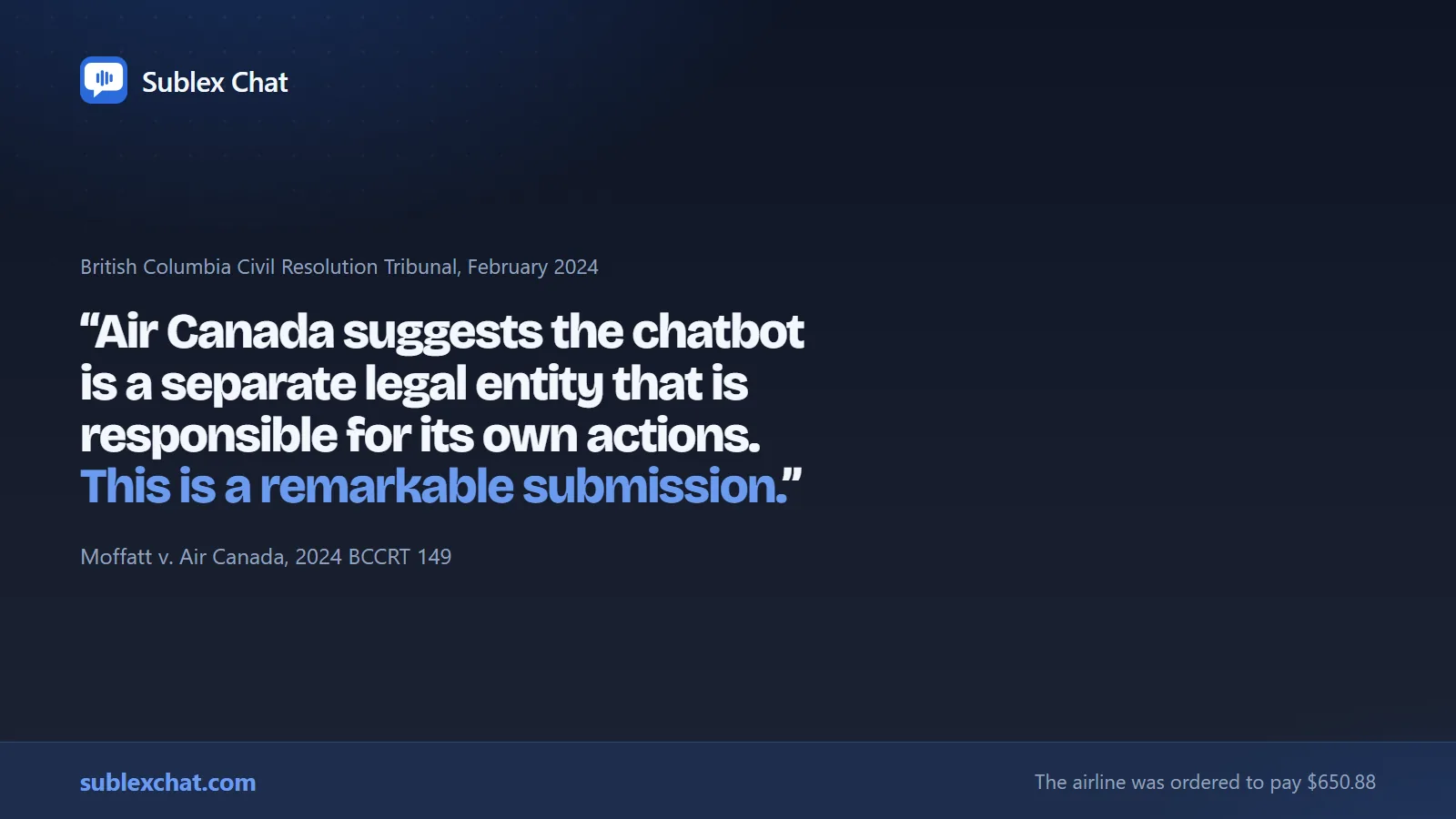
The tribunal’s answer has been quoted in law firm briefings from Toronto to London ever since:
“Air Canada suggests the chatbot is a separate legal entity that is
responsible for its own actions. This is a remarkable submission.”
The reasoning was plain, and that is what makes it portable. The chatbot was on Air Canada’s website. A company is responsible for the information on its own website. It does not matter whether that information sits on a static page or comes out of a chat window, and a customer is entitled to rely on either.
Put in the terms a small business will recognise: your chatbot is your member of staff. If it promises something, you promised it. That sentence is the whole of AI chatbot liability, and everything below follows from it.
Analyses of the decision by McCarthy Tétrault and by the American Bar Association reached the same conclusion. The ruling did not invent a new principle. It applied an old one to a new box on a website.
Why AI chatbot liability hits small businesses hardest
It is tempting to file that case under things that happen to large companies with legal departments. The opposite is true, for three reasons.
The sums are proportionally larger. Air Canada could absorb $650.88 and a week of unflattering press. A guest house that has promised a room rate it cannot honour, a clinic that has confirmed an appointment that was never in the diary, or a garage that has quoted a repair price it will lose money on, cannot absorb it as easily. The refund is not the whole cost either. The argument at the front desk is worse.
The exposure is higher. The cheapest assistants to install are general purpose ones, and a general purpose assistant is built to always produce an answer. Asked something it doesn’t know, it won’t stop. It will produce the most plausible sounding sentence available, in your brand’s voice, to your customer, at 11pm on a Sunday, with nobody watching.
That isn’t a bug in those systems. It’s what they’re for.
Nobody is checking. A large company has somebody reading transcripts. A six person business has nobody reading them, which means the first you hear of an invented promise is a customer standing in front of you holding a screenshot.
Where the risk actually comes from
AI chatbot liability does not come from automation. It comes from improvisation, and the two get confused constantly.
An assistant that answers “we open at nine” because your opening hours page says you open at nine has automated something. An assistant that answers “yes, we can fit you in tomorrow morning” because that is the sort of thing a garage usually says has improvised. Improvisation is where the exposure lives.
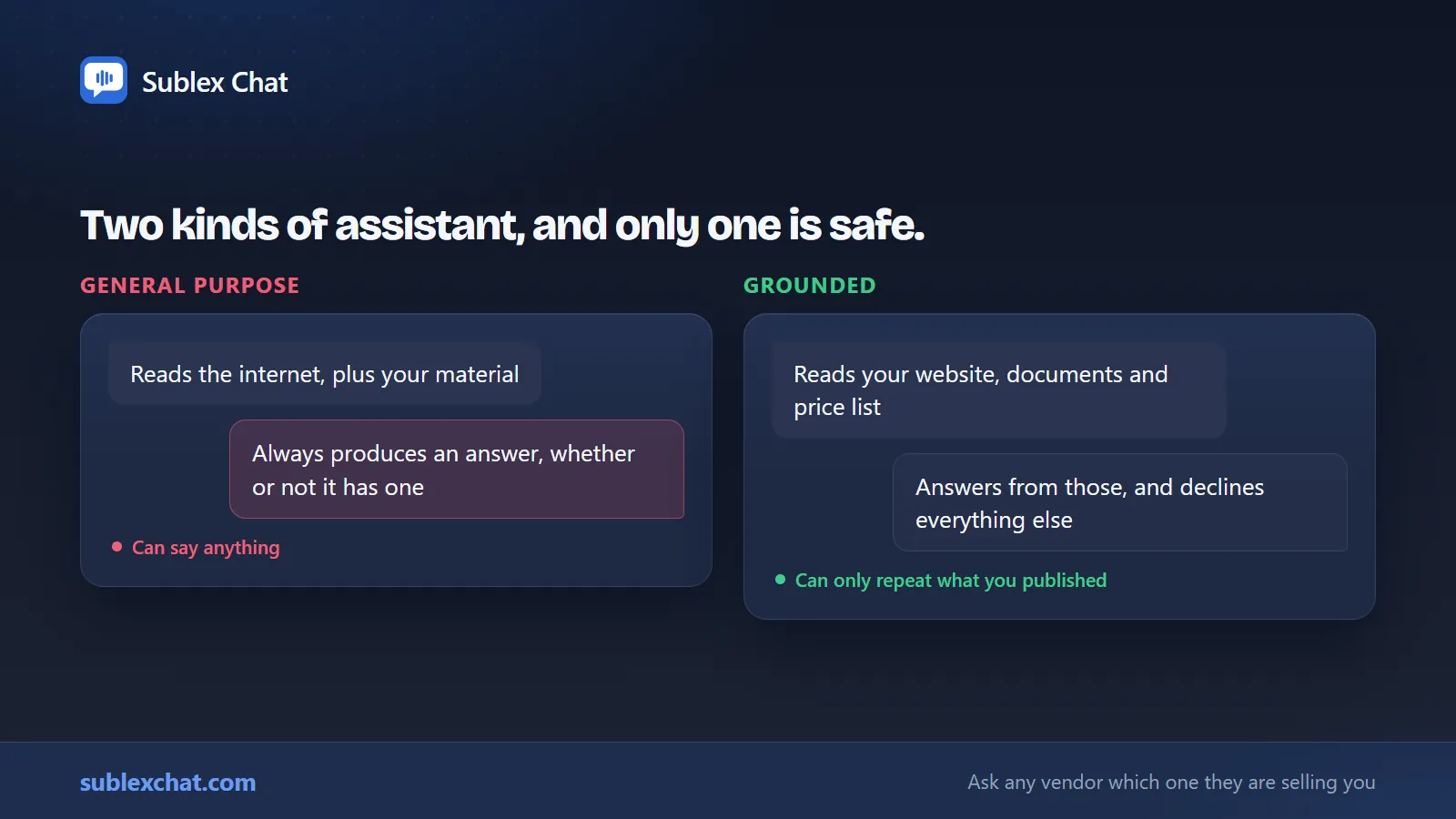
Every assistant on the market falls into one of two groups.
Grounded assistants answer only from material you supply: your website, your documents, your price list. Asked something outside that material, they say they do not know. The worst case is an unanswered question.
General purpose assistants answer from a large model trained on the internet, with your material added on top. Asked something outside your material, they will still produce an answer, because producing an answer is the job they were built for.
For a business selling appointments, rooms, repairs or anything with a price attached, only the first kind is safe. This is not a feature comparison. It is a category decision, and it should be made before you look at a single price.
Three questions that decide your exposure
If you are considering an assistant for your website, these three questions are worth more than any feature list. Email them to a vendor and the answers will tell you more than an hour of demonstration.
1. Where does it get its answers from?
There is a large difference between an assistant that has read your website and one that has read the internet and also your website. The first can only tell customers things you have already said in public. The second is capable of anything.
Ask directly: can this assistant answer from anything other than the material I give it? If the answer is yes, or if it’s vague, you’re accepting the Air Canada risk knowingly.
2. What does an AI chatbot do when it doesn’t know?
Nobody asks this one and everybody should. Every demonstration shows the assistant answering perfectly. Almost none of them show what happens when the answer isn’t there.
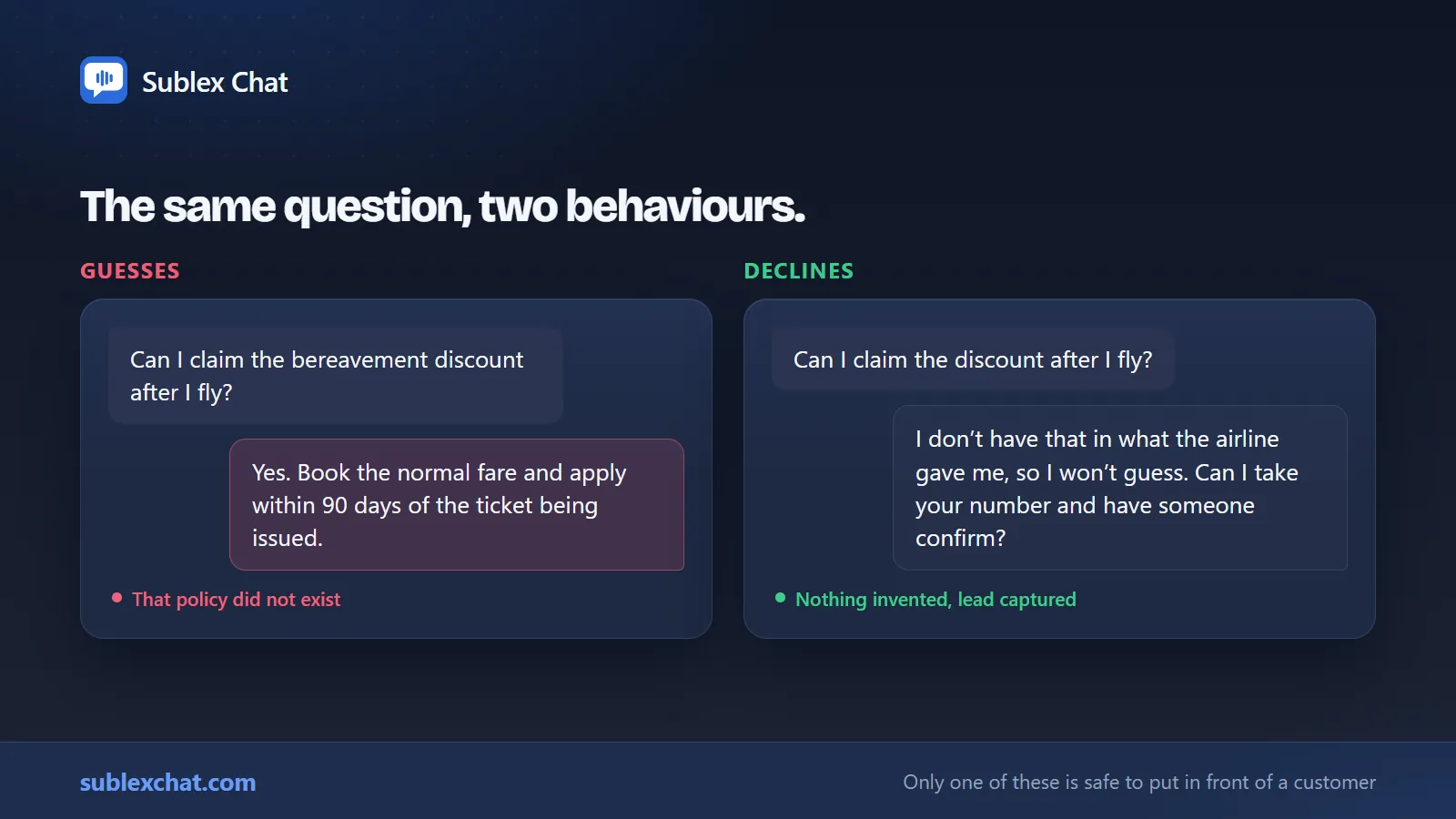
There are two possible behaviours and only one of them is safe. An assistant that says “I don’t have that, let me take your number and someone will confirm” has cost you nothing and handed you a lead. An assistant that invents a delivery date has cost you a customer, and possibly a good deal more.
Insist on seeing it. Ask the vendor to show you their assistant failing. If they will not, or cannot, that is your answer.
3. Can a person take over?
Some conversations should not be handled by software at all. A complaint. A refund. A customer who is already upset. If there’s no way for a human to step into the conversation, every one of those goes to whatever the machine decides to say next.
A handover is not an email to an address nobody reads. It is a real notification to a real person who is expected to reply.
Four rules that remove almost all AI chatbot liability
None of this is an argument against putting AI on your website. Customers genuinely do ask the same questions all night, and a business that answers them wins work from one that doesn’t.
It’s an argument for a specific kind of AI. Four things to insist on:
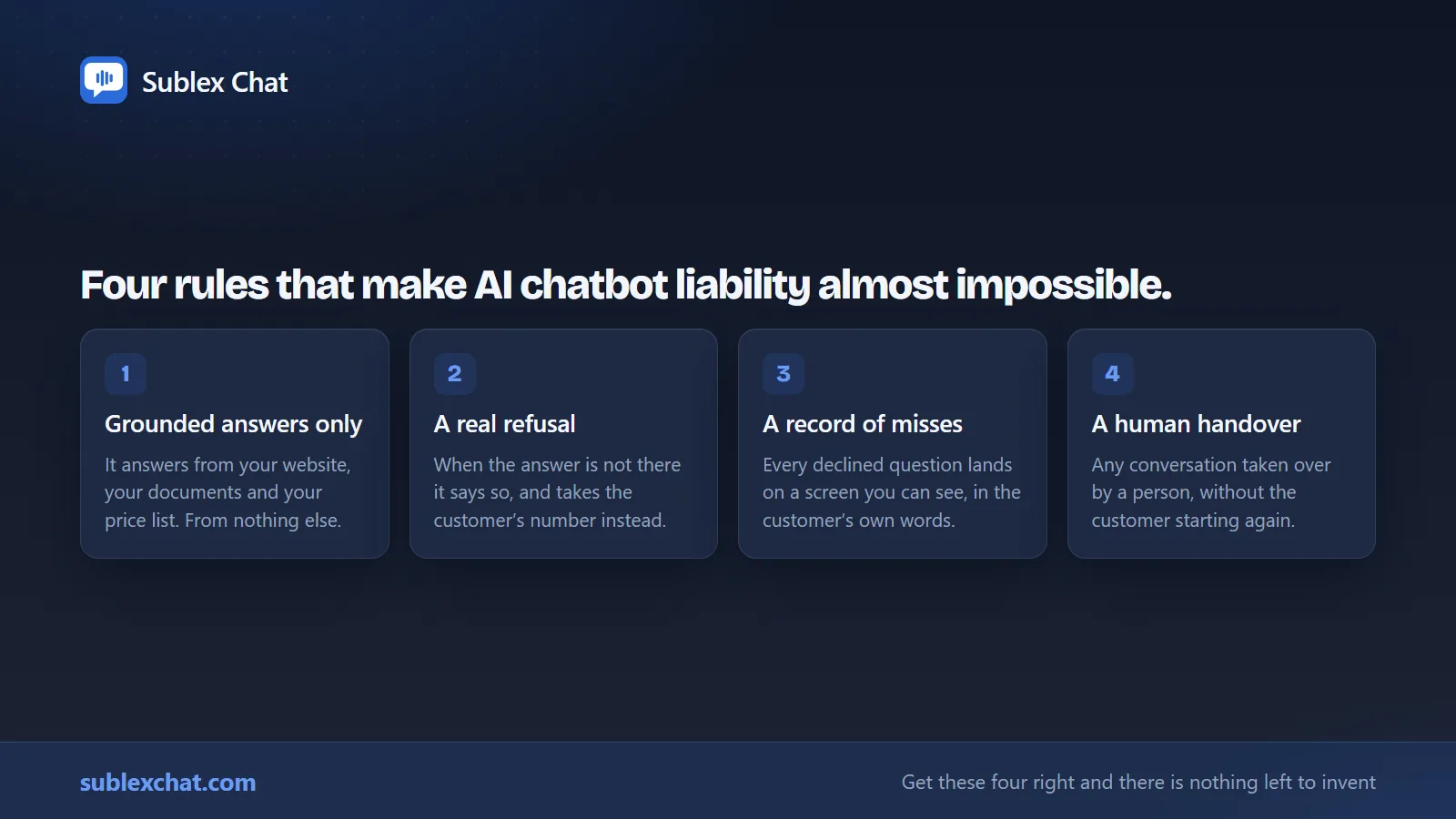
- Grounded answers only. The assistant answers from your website, your documents and your price list, and from nothing else.
- A real refusal. When the answer is not in your material, it says so rather than guessing, and takes the customer’s contact details instead.
- A record of what it could not answer. Every declined question should land somewhere you can see it. That list is the most useful thing the software will ever give you, because it is your customers telling you what your website forgot to mention.
- A human handover. Any conversation, at any moment, taken over by a person, without the customer having to start again.
Get those four right and the Air Canada scenario is not really available to you. Your assistant can only repeat things you have already published. The worst case is that it doesn’t know something, says so, and hands you a lead.
What getting it wrong really costs
The tribunal award is the smallest part of the bill. When a website assistant invents something, a small business usually pays in four places.
Honouring the promise. In most cases you will honour it, because arguing with a customer holding a screenshot of your own website is a fight you lose whatever the outcome. Budget for the difference.
The time. An hour on the phone, an hour writing an email, an hour explaining it to whoever is on the desk. For an owner who is also the person answering the phone, that is the real cost.
The review. One star, saying “they told me one thing and did another”. It outlives the refund by years and it’s the review a future customer reads first.
The retreat. The most expensive outcome is the quiet one. You switch the assistant off, go back to answering everything by hand, and lose every after hours enquiry you had started to win. A bad first attempt at automation often costs a business two years of not trying again.
What to do if it has already happened
If an assistant on your site has already promised a customer something you cannot honour, the order of the next four steps matters more than the wording.
Honour it if the amount is survivable. The cheapest version of this problem is the one you pay and forget. Weigh the difference against an hour of your time, a possible review and the chance of a small claim, and most of the time the arithmetic is obvious.
Screenshot the conversation before anything else. Some tools trim transcripts after thirty days. If this does become a dispute, the conversation is the evidence, and it is evidence in your favour as often as against you.
Fix the source, not the sentence. The assistant said it because your material either contradicted itself or did not cover the question. Correcting the underlying page stops the same promise being made to the next twenty people; telling the assistant off does nothing at all.
Then decide whether the tool is the right one. One invented answer is a gap in your material. A pattern of them is a product that improvises, and no amount of tidying your website will fix that.
How to check a vendor in ten minutes
Copy these five questions into an email. Any vendor confident in their product answers all five in a sentence each. The ones who cannot will take a paragraph to say nothing.
- Can the assistant answer from anything other than the material I give it?
- Show me what it does when it does not know the answer.
- Is the AI included in the plan price, or charged separately?
- What does it cost to remove your branding from my website?
- Can I see every question it could not answer, in the customer’s own words?
If you would rather somebody else asked them, that is part of what a web design agency is for. We do this for clients as part of our web design and AI services, and we have had the conversation often enough to know which answers are evasions.
An assistant built to refuse
Those four rules are not a wish list. They are the specification we built Sublex Chat to.
It reads the material a business already has, its website, its documents, its price list, and answers from that and nothing else. It cannot improvise a price, an opening time or an appointment, because it has nowhere to improvise from. When the answer is not there it says so, takes the customer’s number, and puts the question on a screen in the owner’s dashboard with a button to answer it once. Any conversation can be taken over by a person mid flow, with the assistant going quiet until it is handed back.
We built it because we kept having this exact conversation with clients who wanted a chatbot and were right to be nervous about one. If you are weighing up whether your site is ready for one at all, the warning signs you need a website redesign is a reasonable place to start, because an assistant can only be as good as the website it reads. If you are earlier than that and still costing the whole thing up, we have written about what a website costs in The Gambia as well.
It opens to everyone on 7 September 2026. You can talk to it before then, in the corner of sublexchat.com. It is answering from our own site, and it will tell you when something is not there.
Frequently asked questions about AI chatbot liability
Is a business legally responsible for what its chatbot says?
In Moffatt v. Air Canada, 2024 BCCRT 149, the tribunal held that Air Canada was responsible for inaccurate information given by the chatbot on its own website, and rejected the argument that the chatbot was a separate legal entity. Law differs by country, but the practical position on AI chatbot liability is similar in most of them. A customer reasonably relies on what your website tells them, and a chat window is part of your website.
What is an AI hallucination?
It is when an AI system produces a confident answer that is not true. It isn’t lying, because there’s no intent. The system is built to produce the most plausible next words, and when it has no information it produces plausible words anyway.
How do I stop my chatbot inventing answers?
Use one that can only answer from material you supply, and that is designed to decline rather than guess when the answer is missing. Ask the vendor to show you what happens when it doesn’t know. If they can’t show you, that’s your answer.
Does a disclaimer protect me from AI chatbot liability?
Not reliably. Air Canada’s correct policy was published on its own website and the tribunal still found for the customer, on the basis that a customer is not expected to work out which part of a company’s website to believe. Treat a disclaimer as tidiness rather than protection.
Should a small business use an AI chatbot at all?
Yes, if it is the right kind. The risk isn’t automation, it’s improvisation. An assistant restricted to your own material, that hands over to a person when it cannot help, removes a real workload without adding a real risk.
What does an AI chatbot cost a small business?
Between nothing and around $30 a month for most small businesses. Check three things before comparing any two products: whether the AI is included or charged separately, what it costs to remove the vendor’s branding from your own site, and whether you are billed per message or per conversation.
Photograph
The hero photograph is a departure board at Brisbane airport, by Joseph Bobadilla on Unsplash.
Sources
- Moffatt v. Air Canada, 2024 BCCRT 149, British Columbia Civil Resolution Tribunal, February 2024
- Analysis by McCarthy Tétrault and by the American Bar Association Business Law Today, February 2024