Ask most school administrators in The Gambia whether their school needs a website, and the honest answer is usually a variation of the same response: “We manage through WhatsApp and Facebook, and parents find us by word of mouth.” That may have been enough five years ago. It is not enough now.
Mobile internet connections in The Gambia now exceed the total population, according to DataReportal’s Digital 2025 report [opens in new tab]. Parents, families relocating from abroad, NGO staff arriving in the country, and diaspora families researching options for relatives all start their search the same way: they go online. A school with no website is invisible to all of them.
This post covers the seven specific reasons a school website in The Gambia is no longer optional for any school that takes its reputation and enrollment seriously, what that website should actually include, and answers to the questions school administrators ask most often before they start.
Table of Contents
Why a School Website in The Gambia Matters More Than Most Administrators Realise
Private and independent schools in The Gambia operate in a genuinely competitive market. Parents choosing between fee-paying schools are making a significant financial commitment, and they research their options carefully before committing. The schools they are most likely to call, visit, and ultimately enroll their children in are the ones that make a credible, organised first impression.
Some of The Gambia’s leading schools already understand this. SBEC International School and the British International School Gambia both have professional websites that communicate their curriculum, facilities, achievements, and admission process clearly. These sites do quiet, continuous work: attracting enquiries, building confidence in parents who have never visited, and reaching families who would never have found the school through word of mouth alone. For schools without a website, the gap is growing.
The argument is not theoretical. It comes down to seven specific, practical reasons, each of which affects enrollment, reputation, and the long-term standing of the institution. It is the same case that applies to every type of business, as laid out in the post 7 Proven Reasons Every Business in The Gambia Needs a Website. For schools specifically, the stakes are even higher because the decision being made is about a child’s education.
1. Parents Search Online Before They Visit
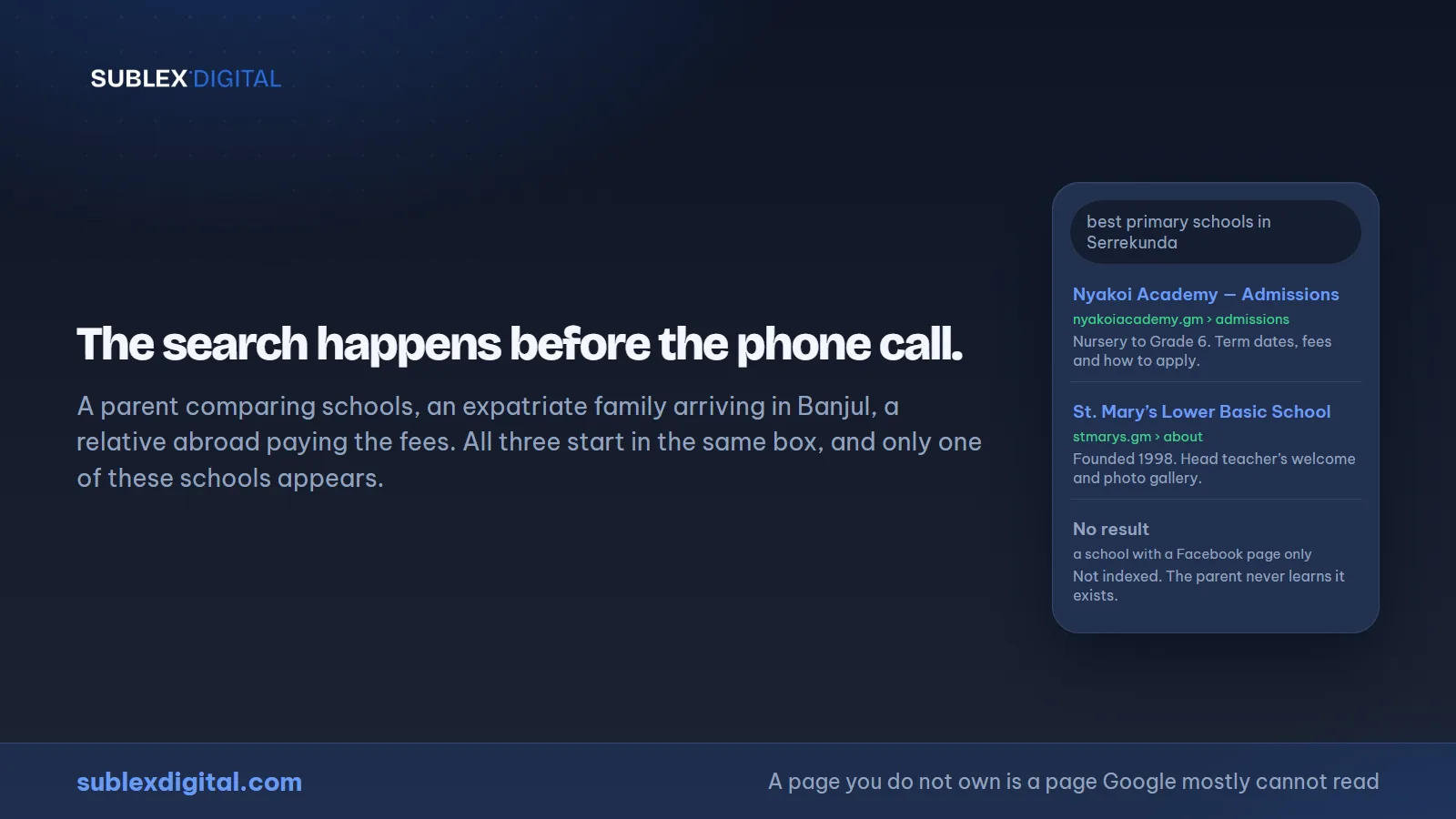
Before a parent calls your school, writes a note to the gate, or asks a neighbour for a recommendation, a significant and growing number of them search online first. They type the school name into Google. They search “private schools in Serrekunda” or “schools near me with IGCSE.” If your school has no website, nothing comes back. The parent moves on to a school that does have one.
This is not a future trend. It is happening now. Mobile internet access in The Gambia has expanded rapidly, and searching for information on a smartphone is increasingly the first action parents take when they want to know more about a school. The school that shows up with a clear, professional website at that moment has an immediate advantage over every school that does not.
Word of mouth still matters in The Gambia, and it will continue to matter. But even a parent acting on a personal recommendation will search for the school before they visit. What they find, or do not find, shapes how confident they feel about following through.
2. A School Website in The Gambia Builds Credibility Before Parents Arrive
Credibility is everything in education. Parents are entrusting you with their children and paying fees to do so. They need to feel confident before they walk through the gate, and increasingly, that confidence is built or lost online.
A school with a well-structured website that shows the school building, introduces the head teacher, lists the curriculum and exam results, and explains the admissions process signals immediately that it is a serious, organised institution. A school with no website, or one that has only a Facebook page with sporadic posts, signals the opposite, even if the quality of education inside the school is excellent.
This matters especially for families arriving from outside The Gambia. Expatriates, NGO staff, embassy employees, and diaspora families returning home all research schools online before they arrive. They have no local network to ask. The school website in The Gambia is, for these families, the only impression they have of the institution before they visit. If that impression is strong, they are far more likely to make contact. If there is no website, they simply choose a school that has one.
3. It Gives Prospective Families the Information They Need
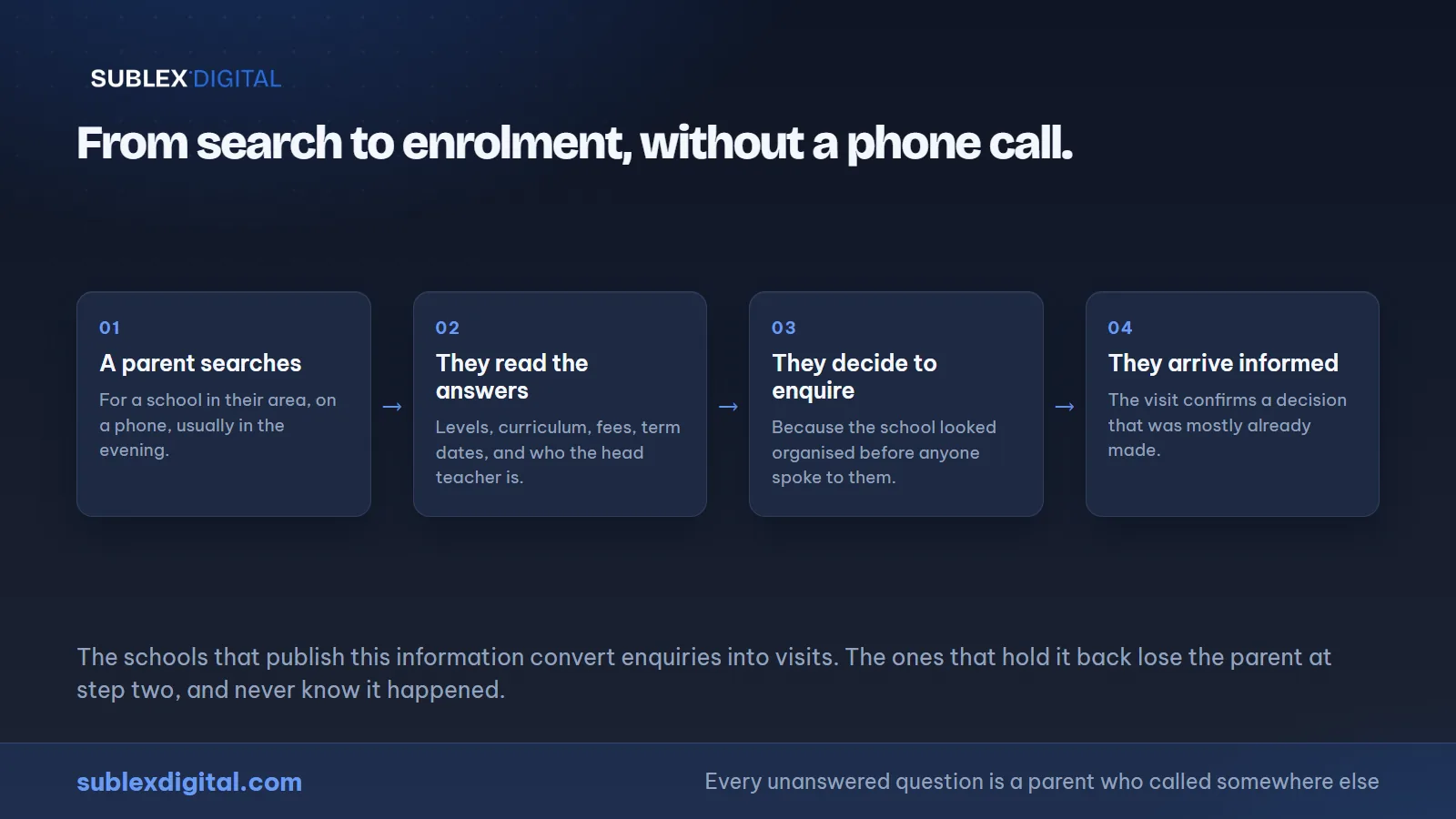
One of the biggest frustrations parents face when researching schools is not being able to find basic information. What curriculum does the school follow? What are the term dates? What is the fee structure? How does the admissions process work? Who is the head teacher?
Without a website, the only way to get these answers is to call, visit, or ask someone who already has a child at the school. That creates friction. Many parents will not make that call until they have already decided they are interested, and they will not get interested without first finding the information they need. A school website removes that friction entirely. Parents can find out everything they need to know at any time, without having to contact anyone, and arrive at the gate already informed and ready to proceed.
The schools that make this information easy to find are the ones that convert enquiries into admissions most efficiently. The information does not need to be exhaustive. It needs to be clear, accurate, and easy to find on a phone screen.
4. You Can Reach Families Your Competition Cannot
Most schools in The Gambia rely on their immediate geographic area for enrollment. Parents nearby hear about the school and enroll. The school grows steadily but slowly, constrained by how far word of mouth travels. A school website in The Gambia removes that constraint.
A well-structured website with the right content can attract families from across The Gambia who are moving to a new area, families from the diaspora who are returning home and want to settle children before they arrive, and international families who are relocating to The Gambia for work. None of these families are reachable through the school gate or the local community. All of them can be reached through a website. The post 5 Real Reasons Your Online Presence in Gambia Is Costing You Customers covers this pattern in detail. The principle applies as directly to schools as it does to any other institution.
Schools that are early to build a strong online presence in their category will own search results for their area and their curriculum type for years. The schools that wait will find that ground already occupied by competitors who moved first.
5. It Keeps Current Parents Informed and Engaged
A school website is not only for attracting new families. It is also a communication tool for the parents you already have. Term dates, exam timetables, upcoming events, notices about school closures, staff changes, and important announcements can all live on the website and be updated in minutes.
This matters because the current reality for most Gambian schools is that parent communication happens through individual WhatsApp messages, printed notices that get lost in school bags, or word passed between parents at the gate. These channels are inconsistent and easy to miss. A website gives every parent access to the same accurate, up-to-date information without anyone having to chase it down.
When parents feel informed and connected, they are more loyal to the school, more positive in what they tell other parents, and more forgiving when things occasionally go wrong. A website is one of the simplest and most cost-effective tools a school has for building that relationship.
6. Your School Appears in Google Search Results
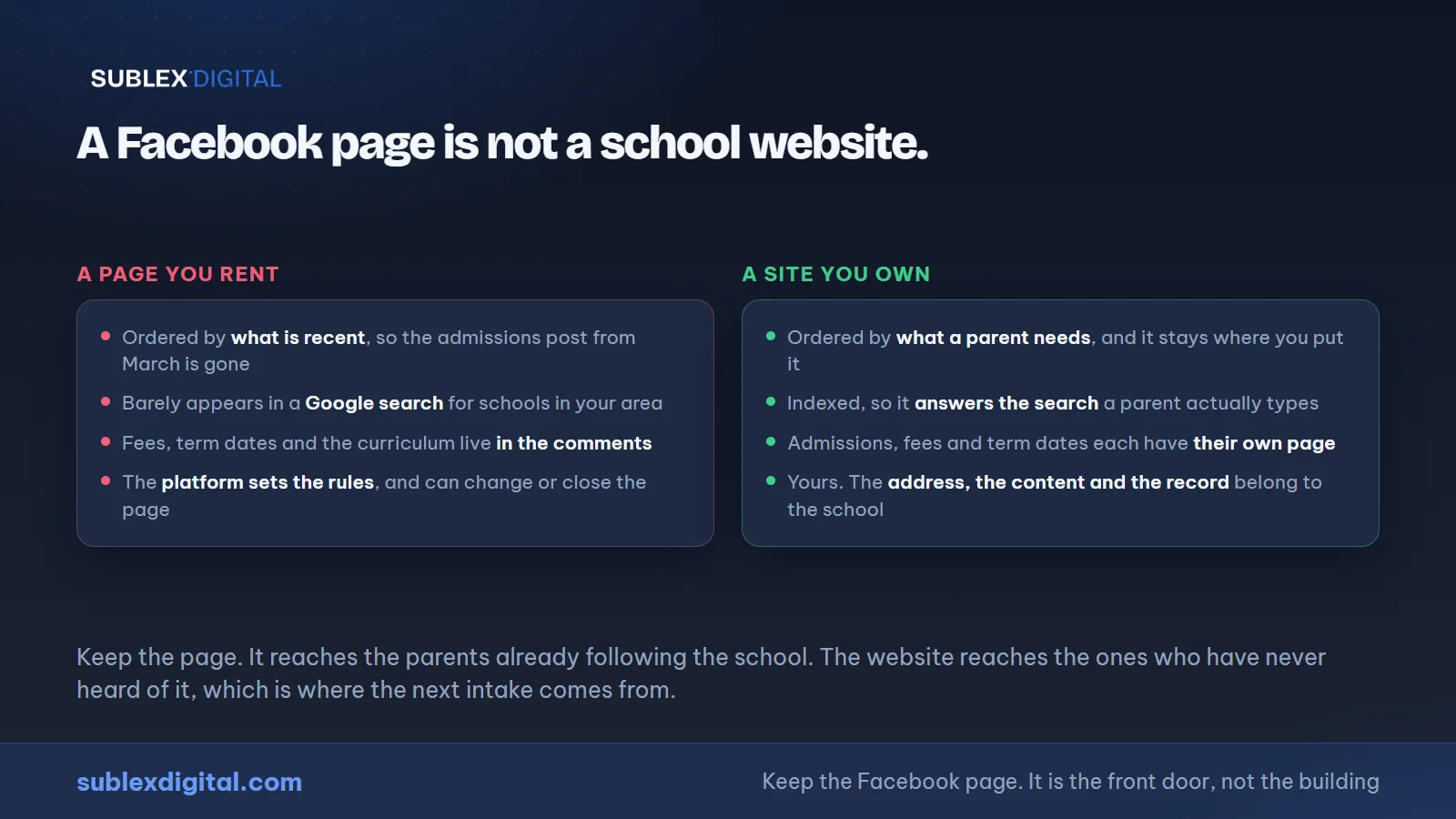
Google is where parents go when they are searching for a school and have no specific recommendation to start with. They search for schools in their area, schools following a particular curriculum, or schools with strong exam results. If your school is not on Google, it does not exist in that search. A school with a well-maintained website can appear in these results consistently and for free, without spending on advertising.
This is one of the most significant advantages a school website provides over social media. A Facebook page does not rank meaningfully in Google search results for someone searching “secondary school Serrekunda” or “Cambridge school Gambia.” A properly built website does. Every month, that visibility generates enquiries that cost the school nothing and would otherwise never have arrived.
The effect compounds over time. A school that has had a website for two years, posting relevant content regularly, has a substantial and growing advantage in search visibility over a school that launches a website today. The earlier a school invests in its online presence, the greater the long-term return.
7. A Website Shows Students and Staff That the School Takes Technology Seriously
Education and technology are increasingly inseparable. Parents who are investing in their child’s future want to know that the school is keeping pace with the world their child will graduate into. A school that cannot maintain a functional website sends a quiet but clear signal about how it approaches technology more broadly.
The opposite is also true. A school with a clean, professional website that is clearly maintained and updated demonstrates that the institution is forward-looking, organised, and serious about its digital presence. That impression extends to how parents perceive the school’s approach to ICT in the classroom, exam preparation, and preparing students for a world where digital literacy matters.
For students themselves, seeing their school represented professionally online is a source of pride. It makes them more likely to mention the school positively to friends and families, and it reinforces the sense that they are enrolled in an institution that takes itself seriously.
What a Good School Website in The Gambia Should Actually Include
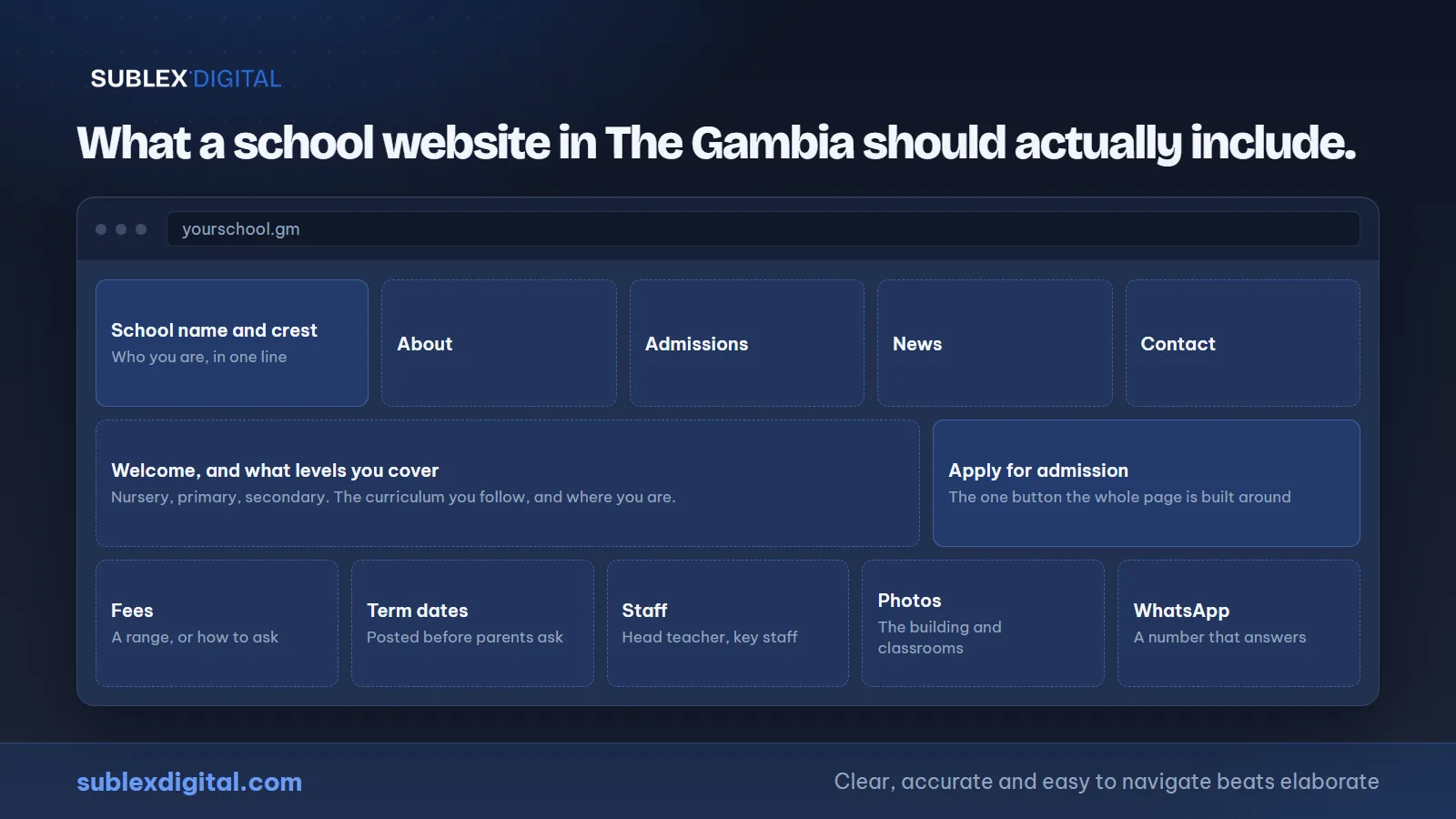
A school website does not need to be complicated. It needs to be clear, accurate, and easy to use on a phone. Here is what every school website in The Gambia should have as a minimum.
A homepage that immediately communicates who the school is, what level it covers (nursery, primary, secondary), what curriculum it follows, and how to get in touch. The first impression should take less than ten seconds to understand.
An about page covering the school’s history, mission, values, and a brief introduction from the head teacher or principal. This is where parents decide whether the school’s culture matches what they are looking for.
An admissions page that explains the enrollment process clearly. What documents are needed, how to apply, when the intake periods are, and who to contact. This page eliminates the need for parents to call just to understand how to apply.
A fee information section. This does not need to publish exact figures if the school prefers to discuss fees directly, but it should at minimum indicate the fee structure and invite enquiries. Transparency here builds trust.
A news or events section where the school can post term dates, exam schedules, upcoming events, and achievements. This section keeps the website current and gives parents a reason to return.
Staff profiles for key teaching and administrative staff. Names and brief bios help parents feel they are enrolling their child with real people, not an anonymous institution.
A contact page with a working phone number, email address, physical location, and a WhatsApp link where applicable. The fewer steps between a parent and making contact, the more enquiries convert to visits.
Most of what a school office answers by telephone is the same short list of questions: when the term starts, what the fees are, whether there is a place in Grade 3, what a new family needs to bring. Once those answers are on the website they can also be given out at any hour. Sublex Chat, our own assistant, answers only from what the school has published, says plainly when it does not know something rather than guessing, and keeps a list of the questions it could not answer. For a school, that list is worth reading on its own: it is prospective parents saying, in their own words, what the website forgot to mention.
Sublex Digital builds websites for schools in The Gambia that cover all of these elements, are fully mobile-optimised, and can be updated by school staff without needing a developer. You can see examples of completed educational institution projects on the Sublex Digital portfolio, or review the full range of web design services available. For more on what to look for when choosing a web design partner, the post 6 Critical Things to Check When Hiring a Website Design Company in The Gambia is a practical guide.
Frequently Asked Questions About School Websites in The Gambia
These are the questions school administrators most often ask before starting one.
How much does a school website in The Gambia cost?
The cost of a school website in The Gambia depends on the size and complexity of the site, the number of pages needed, and what infrastructure is required. Sublex Digital scopes every project individually so the price reflects the actual requirements. The post How Much Does a Website Cost in The Gambia? explains the factors that affect cost. The best starting point is a free consultation to discuss your school’s specific needs.
Can a school in The Gambia update its own website without a developer?
Yes. A school website built on WordPress with a well-configured content management setup can be updated by administrative or teaching staff without any coding knowledge. Adding news posts, updating term dates, uploading exam results, and changing contact information are all straightforward tasks in a properly built WordPress site. Sublex Digital includes CMS training as part of every website project so your team can manage the site independently from day one.
What pages does a school website need?
At minimum, a school website needs: a homepage, an about page, an admissions page, a fees or contact page, and a news or events section. Additional pages can cover specific programmes, extracurricular activities, exam results, staff profiles, and a gallery. The structure should reflect what parents and prospective families actually need to find. Start with the essentials and expand as the site grows.
Should a school website publish its fees?
This depends on the school’s preference. Some schools choose to publish fee ranges to help parents self-qualify before enquiring. Others prefer to invite enquiries and discuss fees during a visit or call. Either approach can work. The most important thing is that the website makes it easy for a parent to take the next step, whether that is filling in a form, calling, or sending a WhatsApp message. Leaving no contact route at all is the approach that costs the most enquiries.
Can a school website help with enrollment?
Yes, directly. A school website that shows up in Google search results, communicates the school’s curriculum and values clearly, and makes the admissions process easy to understand will generate enrollment enquiries that would not otherwise arrive. Research consistently shows that the majority of parents search online before deciding which schools to visit. Schools with strong websites are the ones that make that shortlist. Schools without websites are rarely considered by the families who found their options through a search.
What is the difference between a school website and a school Facebook page?
A Facebook page is useful for posting updates and engaging with parents who already follow the school. But it does not rank in Google search results, it cannot be structured to guide a new parent through the admissions process, and it is entirely dependent on a platform you do not own or control. If Facebook changes its algorithm or your page gets restricted, your entire online presence disappears. A website is an asset the school owns. It appears in search results, can be structured for any purpose, and is not subject to the decisions of a third-party platform. A Facebook page and a website work best together. A Facebook page alone is not a substitute for a website.
Is Your School Ready for a Website?
A school website in The Gambia is one of the most direct investments a school can make in its own future. It works while the school is closed, reaches families the gate never could, and gives prospective parents the confidence to make contact. The schools that build this foundation now will hold a compounding advantage over schools that do not as more parents move their search online.
If your school is ready to take this step, book a free consultation with Sublex Digital. We will discuss exactly what your school needs, what the process involves, and what the right website looks like for your institution. No obligation. No pressure.